This post was originally written in November 2024.
WordPress was great until about a decade ago.
It was open source, which meant it could be free. It was simple and straightforward to use. It was customisable to the point where even non-technical users could build websites that didn’t look like WordPress sites.
WordPress’s stated philosophy was about democratising online publishing. Anyone could do it. You didn’t need skills or deep pockets. You could fire it up, get online and blog.
Unwelcome change
Then around a decade ago, the team behind WordPress began tinkering with it. It became bloated and complicated. It did what software companies often do: It added features that many users neither asked for or wanted.
This meant WordPress sites became cumbersome. There were ways of taming this process, but only up to a point.
WordPress site owners found they were being penalised by Google in search listings as their sites became slower. This was a warning of what was to come.
Gutenberg
Gutenberg was the first clear sign that WordPress was heading in the wrong direction.
For years WordPress was the best way to build a blog or a basic editorial web site.
It was straightforward. Although it needed some technical know-how, early WordPress was accessible. There was a great community of users willing to share information and help newcomers.
Online tutorials, user meetups and WordCamps filled in the gaps.
For a while it felt as if Wordpress really was democratising publishing.
The beauty of simplicity
You didn’t need programming skills to dig into early WordPress. But if you wanted to do more than the basics, there were easy-to-install plug-ins to add functionality.
Likewise there were many themes that let you change the look and feel of your site. Even non-developers could take things further by digging in to the CSS or tweaking lines of PHP code.
This simplicity meant it was easy to get information in and out of WordPress. In particular, I could take a blog post, find the underlying HTML code, then cut and paste it into another CMS for instant syndication.
Before and after Gutenberg
Gutenberg changed everything. Before Gutenberg you would write posts in an editor that resembled a text editor like IA Writer. Gutenberg replaced this with an editor that treats every element, text, images and so on, as a block.
Some people, maybe many people, find this approach more useful. It certainly works well for building more sophisticated sites, but this comes at the cost of making WordPress more complex.
It is harder to learn Gutenberg than the TinyMCE editor it replaces.
Page design
If pre-Gutenberg WordPress was like using a text editor, the current edition is more like Adobe’s InDesign. You need to take a training course to learn InDesign; mastery takes years.
Before Gutenberg, WordPress focused on creating great blog posts. Writers could concentrate on words and finding pictures to tell better stories.
Gutenberg is more concerned with layout, how things look on a web page. This can be distracting. It is an invitation to prevarication. There’s a risk it gets in the way of productivity. It certainly gets in the way of writing editorial.
Gutenberg’s gifts
Gutenberg is great for professional website builders. It gives them flexibility.
That extra layer of complexity that leaves casual WordPress users bewildered or in the cold means they can do more. It gives them ways to charge more and it creates a usability barrier which is, in itself, a commercial opportunity.
Professionals can use Gutenberg to design bigger, better sites with more features and functionality.
They can also sell custom blocks.
At the time it looked as if Wordpress was pushing Gutenberg in order to compete with companies like Wix and Squarespace which were proprietary alternatives for companies building commercially focused websites.
The newcomers were eating WordPress’s lunch in these key markets.
While the change may have made commercial sense, it sent WordPress further away from its roots as, essentially a blogging or editorial content management system.
It was no longer about publishing.
WordPress.com
About the same time WordPress.com, the commercial, hosted version of the software found more and more ways of charging users. Running a WordPress.com site went from pocket money pricing to we-could-take-the-entire-family-out-for-dinner pricing. To be fair this would depend on which options you chose to buy.
WordPress also dragged out the huge, sprawling Jetpack plug-in which was a way of getting people with open source, self-hosted Wordpress sites to pay subscriptions. A handful of important features were wrapped into Jetpack making the subscription essentially compulsory for any but the most casual, disengaged user.
This was the second sign that Wordpress was no longer the idealist democratic publishing service it once was. It was clear it was out to maximise income.
It’s hard to complain about that. We live in a commercial world. But we don’t have to like it or accept it.
I didn’t sign up for a full CMS
I didn’t want an all-singing, all-dancing content management system. For a few years I tinkered with WordPress themes and plug-ins that stripped the complexity, bloat and sluggishness from the software. Until I realised this was a losing battle.
My first website was a hand-coded, flat affair written in HTML and CSS with no database. I considered returning to this, although with 1500 posts that was a daunting prospect.
Since then I settled for Ghost and Micro.blog. The two options offer different approaches, different features. Ghost is clearly aimed at journalists, bloggers and online publishers. It is closer to the Wordpress goal of democratising publishing. Micro.blog can be used that way, but it also functions as an alternative to social media.
I didn’t see the recent WordPress controversy coming a decade ago, but by three years ago when I switched away from WordPress it was clear something like this was on the way.
As it says earlier in this post, I didn’t leave WordPress, WordPress left me.
Last night I joined old friends and colleagues in raising a glass to the late Randal Jackson. It was the an appropriate send-off, something Randal would have enjoyed himself.
Over the years Randal was a rival, a colleague and a mate. Sometimes all three at once.
In the early 1990s I was working a freelance technology journalist in Wellington. There were others in town, but Randal was the most likely to turn up at the same jobs and events as me.
Often we’d be the only two journalists in the room. Depending on the time of day, we’d would repair to a bar afterwards to talk over whatever story was on offer and others besides.
It didn’t always depend on the time of day. Randal was happy to visit the bar any time.
The Randal Jackson breakfast show
At one alleged breakfast event I sat down next to Randal at 7am in a private meeting room at what was then called the Wellington ParkRoyal.
Two earnest American IT executives were there to talk about whatever overpriced product their company was trying to foist on New Zealand at the time.
About ten minutes in to the session it was clear they weren’t planning to give us breakfast. The mean swine hadn’t even organised coffee.
Randal wasn’t happy. He told them to stop. He said that in New Zealand an invitation to breakfast usually meant some kind of food and certainly meant hot coffee.
Fair enough. Apart from anything else we could smell the food and coffee in neighbouring rooms.
He turned to me, winked, then said: “I bet you didn’t have time to eat before coming in Bill?”.
It was a question. I told him he was right and that I was hungry.
Randal then said how he was also hungry, too hungry to think about difficult topics like enterprise computing on an empty stomach.
The strait-laced Americans were mortified. They looked confused and worried. Nevertheless they decided to bat on regardless.
Randal put his pen on his pocket, picked up his notebook, winked again and said: “Come on Bill let’s go and find some breakfast”.
We got up to leave.
“Now just wait”
The senior executive said something like “now just wait” then gave instructions to his junior. The younger executive left the room.
Five minutes later waiters entered with a coffee pot, a tea pot and croissants. This was more like it. The session resumed.
After another five or ten minutes a huge trolley rumbled in piled high with fresh fruit, eggs, bacon, sausages, the works. There was easily enough food for ten people.
We tucked in and listened, questioning the execs for another ten minutes before they took off for meetings. We demolished piles of food. They ate nothing. I guess they had their power breakfast before our session.
When, not long after, they stood to leave , the senior executive said if there was anything else we wanted we could just order and he would pick up the bill.
That was a bad move.
After they had gone I turned to Randal and asked: “Champagne?”. In those day fancy breakfast functions often included sparkling wine or Buck’s Fizz.
Randal said no, and ordered cognac instead. And coffee. And more of those little Danish pastries.
We didn’t get out of the ParkRoyal until lunch time, and only then because there was a horse running that afternoon and Randal needed to find a TAB.
“Here’s the bad news: No one is coming to save you. No business is going to swoop in and provide sustainable funding for newsrooms. No new technology is going to transform the way journalism supports itself forever.
“No big, incredible deal is going to build a strong foundation for the news. There isn’t a single magic bullet that will work for everyone. Even producing groundbreaking journalism isn’t going to suddenly turn your fortunes around.”
Werdmuller says journalists need to recognise the internet is not a broadcast medium but a conversation. This is true.
Many journalists use social media as a broadcast medium. They see it as a way to draw in readers to their newspaper, radio or TV channel websites. Whether they post to X (formerly Twitter), Facebook, Linkedin or one of the newer alternatives like Threads, Bluesky and Mastodon, they often simply post a link to their stories hosted on mainstream media sites. In many cases that’s the end of their interactions.
This can be just as true in 2026 as it was five or more years ago.
Yet many New Zealand journalists have learned how to engage with readers online.
This is especially true of the journalists who have pushed out of traditional media boundaries and are no longer employed by major news brands. They may produce podcasts or YouTube video. They may publish on Substack or similar services. They may run email delivered newsletters or more traditional websites.
In the earlier 2020 story I wrote about Twitter, it could apply to any modern social media channel:
“Most use it as a broadcast medium – like a RSS feed. A number have Twitter accounts, but say little of value. Perhaps 40 percent can be said to be serious Twitter journalists.”
Change Twitter to X or any other social media channel and you’ll realise the number hasn’t changed much. Less than half of the journalists visible online use social media to its full advantage.
Social media as a conversation
What has changed is many of New Zealand’s higher profile journalists now have regular active social media conversations. Go and dig around, you’ll see many of the best-known names engaging with their audiences. It can be hard doing this among the snark and antagonism.
One innovation that I previously attempted on my site was to integrate social comments. At the time my site was hosted on WordPress. Back then I used IndieWeb tools to capture tweets or other responses to my posts on stories. I’ve did this to boost the conversational aspect of my work.
Now I have switched the site to Ghost, specially Ghost Pro because it includes the ability to create and send email newsletters. Ghost does not allow the kind of plug-ins that can be used to expand WordPress functionality.
A potential conversational superpower
Instead, it has its own superpower. Ghost publishes to something called the Fediverse.
Thanks to the Fediverse, you don’t need to be “on” a social network in order to interact with people using suitable services such as Mastodon or BlueSky.
When you publish a post on a Ghost site, it can be sent out automatically so people on Mastodon and other fediverse platforms can follow it, see it in their feeds and reply to it.
What this means from the reader’s point of view is that:
They can follow your site like they would follow a person
Your posts automatically appear in their timeline
Any replies they make to these Fediverse posts automatically come back to your site.
This means journalists don’t need to broadcast on social media. They can run their websites and newsletters. They don’t actually post to Mastodon or BlueSky. The beauty of this approach is that you are not limited to one social media service. Nor are you even limited to social media… material distributed to the Fediverse can turn up in other ways.
To date my experience using this tools has meant limited interaction. I still get more feedback via email than by the Fediverse. And I still remain active on BlueSky, Mastodon and Linkedin. There are frequent conversations, but they don’t yet all appear under the single Fediverse umbrella.
Building audience relationships
Ben Werdmuller’s story linked to at the top of this post from ends with:
“Until publishers encourage reporters and editors to engage with their audiences, they are going to miss out on the potential of Twitter.
Of course, the journalists who do this best will become media brands in their own right, which will worry the bean counters. But that’s another story…”
This continues to be true many years after those words were written even if Twitter has morphed into the dysfunctional X and other services have replace it..
Many of us who still work as journalists are now mini-brands. Publishers and editors hire journalists with a good brand. Freelancers like me get work on the back of having a brand.
This doesn’t come naturally to older journalists. We taught journalists to keep themselves out of the story. I’m still not 100 percent comfortable inserting myself into stories.
But that’s not how things work today and it definitely isn’t how blogging works.
Werdmuller has a different take on what amounts to the same idea. He writes:
“Instead of thinking in terms of having an audience, you need to think about building and serving a community. Instead of informing, you need to be listening. The opportunities to learn the nuances of your community and to serve it directly are unprecedented — but it takes work.”
It does take work. One of the skills journalists pick up is to be excellent at listening to sources. In the past we’ve not been so good at listening to our audiences. It took me a while, although judging by my earlier posts, I was onto this many years ago.
Some of the institutional knowledge that helped us understand audiences, like newspaper librarians who provided context and memory, has been lost along the way. But journalists can rebuild that connection directly.
The point here is there hasn’t been a clear dividing line between sources and audiences for many years now. Likewise, there is less of a division between journalists and audiences. We are, as Werdmuller puts it, communities. He is right when he says this takes work, but boy, it can be rewarding.
Originally written December 2010, updated September 2025, with additional context added January 2026.
In Costly Mistakes for the American Journalism Review, former newspaper reporter turned industry analyst John Morton argues that many of the steps US publishers took to counter falling advertising revenues in the run-up to the recession only made things worse. His analysis is sharp and remains a must-read for anyone following the newspaper industry.
High margins, short horizons
Morton points out that corporate publishers demanded margins of 20 percent or more from their papers. This was unsustainable. The pursuit of these returns meant cutting the very things that made newspapers valuable—experienced staff, institutional knowledge, deep local coverage.
Family-owned papers had traditionally worked on closer to 10 percent margins, still a healthy return that brought owners influence and prestige along with profit. Owning a paper was lucrative, but the greater rewards were power and status.
Corporations, however, chased higher returns. To keep margins fat, they cut investment and hollowed out editorial quality. By the time the internet arrived, publishers assumed they could leverage their media assets into digital businesses and keep the money flowing.
While huge numbers of readers visited newspaper websites, few stayed long or read deeply. Publishers struggled to understand that digital and print required different approaches, not just digital versions of print strategies.
Writing for Nieman Journalism Lab, Martin Langeveld said publishers needed to grow their online market share rather than erecting barriers. He argued that paywalls and fights with aggregators risked driving audiences away, further shrinking relevance.
Paying for loyalty
Paywalls may strengthen ties with a small core of loyal readers, but at the cost of scale. The risk is that newspapers swap mass reach for narrow influence, losing their role as central public forums.
The industry’s obsession with margins in print and its missteps online meant publishers missed opportunities to adapt. By prioritising short-term profit over long-term sustainability, newspapers undermined both their business model and their place in society.
What could have worked differently
Looking back from 2026, some alternative paths become clear:
Build reader relationships early: Publishers who invested in email newsletters, membership models and direct reader engagement in the early 2000s—before social media dominated—built sustainable audiences. Those who learned to use journalism tools to build communities fared better than those who treated websites as digital print editions.
Preserve institutional knowledge: Cutting newspaper librarians and experienced staff seemed like smart cost-cutting. It proved disastrous. New reporters couldn’t learn from veterans and investigative capacity evaporated.
Avoid the subscription trap alone:Subscription models worked for elite publications but created a second digital divide. A mix of approaches—freemium, micropayments, memberships—might have served democracy better.
None of these guaranteed survival, but they offered better odds than chasing unsustainable margins while hollowing out the product.
The loss of control wasn’t just about business model failures. As newspapers struggled, tech platforms like Google and Facebook became the primary distributors of news, treating journalism as content to drive engagement rather than as a public service.
This shift fundamentally changed who controls what news people see and how they see it. Meanwhile, local journalism withered in many markets, and ad-blocking further undermined remaining revenue streams.
More on journalism and media:This post is part of ongoing coverage about journalism business models, industry decline and missed opportunities:
Originally published July 2018. Updated January 2026 with observations on how subscription fatigue and a proliferation of paid services have reshaped the economics of paying for content.
The subscription explosion
When this post was first written in 2018, the subscription economy was already growing. By 2026, it has exploded—and the problem of limited consumer budgets has only intensified.
The average person now juggles subscriptions to streaming services (Netflix, Disney+, Apple TV+), music services (Spotify, Apple Music), cloud storage (iCloud, Google Drive, Dropbox), productivity tools (Microsoft 365, Adobe) and increasingly, news and journalism services (Substack, Patreon, individual publication subscriptions).
The core insight from 2018 remains true: people allocate a fixed budget to subscriptions, creating fierce competition among publishers, app makers and content creators.
Ben Brooks gets close to the heart of the problem with pay walls when he writes Subscription Hell. It’s hard to make money from pay walls.
The few online sites that do well from pay walls are those like New Zealand’s National Business Review or The Economist. Both serve well-heeled audiences with unique, quality content readers can’t get elsewhere.
Brooks makes two interesting points.
First, differentiation. Brooks is thinking about podcasting, but it applies to all online media. In essence he says there are thousands of undifferentiated podcasts chasing the same audience.
…but will they pay?
The implication is that no-one will pay to listen to one of the podcasts when there are dozens of free alternatives. You could say the same about most online media. This, in part, does not apply to pay wall successes like the NBR and The Economist.
Their audiences don’t have obvious alternatives.
The other point is subtle. Brooks makes the connection between people paying for apps and buying pay wall subscriptions.
On the surface these are two quite distinct markets. And yet, recently I was thinking about exactly this concept from the opposite point of view. I have a number of subscriptions to pay each month. Some are for apps or online services. Others are for, it’s a horrible word to use, but let’s go with it: content.
Pay wall, subscription software: two aspects of the same thing
When budgeting, the two are aspects of the same thing. I allow myself so many dollars a month for subscriptions. It’s a single pool of money to cover digital services like cloud storage, online music, movie downloads, pay walls and apps. What isn’t spent on apps is available for media. What isn’t spent on media can be spent on apps.
A decade ago the budget was zero. By 2018 it had grown. While it still wasn’t a huge amount of money, it was about the same as I spent on coffee. In 2026 it is well past that level. I don’t plan to let it grow higher.
I’m not alone. Two decades ago, in the mid-2000s, the budget for digital subscriptions was essentially zero for most people. By 2018 it had grown to a modest amount. By 2026, the typical household subscription spending has ballooned—one estimate suggests US households now spend over $200 monthly on subscriptions, with many unaware how much they’re actually paying.
The issue is, consciously or not, people only budget so much money for subscriptions. We have a limited pool of funds. So does everyone else. The world has a limited pool of funds for subscriptions.
On a world scale it is huge and the pool is still growing. Even so, there is not enough to go around for everyone who would like to earn money selling pay wall subscriptions or apps.
Too many sellers, too few buyers.
And there’s the problem. It’s not hopeless. Micropayment services and reader-supported platforms have evolved since 2018. Substack, Patreon, Ko-fi and Buy Me a Coffee offer ways for readers to directly support creators. I use New Zealand-based Press Patron and can recommend it.
Some publications experiment with bundled subscriptions or tiered pricing to capture different budget levels. But fundamentally, the challenge remains: too many sellers competing for limited buyer budgets. The newspapers that missed their opportunities to build early subscription habits now face even fiercer competition than they did in 2018.
Yet it’s difficult. The market for content pay walls or subscription software is not infinite.
Subscription fatigue sets in
In 2026, we’re seeing subscription fatigue. People are overwhelmed by the number of recurring charges hitting their accounts. Many have begun rotating subscriptions—subscribing for a month, binge-watching or reading, then canceling until they need it again.
This presents new challenges for publishers and creators who need predictable recurring revenue. The answer isn’t obvious, but journalists who use their core skills to build genuine communities tend to retain subscribers better than those treating it purely as a transaction.
More on journalism and media:This post is part of ongoing coverage about journalism business models, digital adaptation and the subscription economy:
Originally published March 2017. The core argument about journalism serving readers rather than industry remains as relevant today, even as the business model challenges have intensified.
At The Register Shaun Nichols writes:
“The tech press has dared to lean away from its core mission of making technology companies more profitable, says tech advocacy house ITIF.”
Long story short, it says the media moved from a positive attitude towards the industry to confrontation.
This, according to the ITIF, is because being tough on the industry makes it easier for tech media to turn a profit.
It goes on to talk about the media being ‘biased’ and distorts the public view of technology.
Yes, it’s all stuff and nonsense. There’s a lot to unpack, but here are a couple of ideas to think about.
Advertising
In the past publishers made money selling advertising to technology companies. They were a great sales conduit. It worked.
The technology industry was the tech media’s most important customer. Rivers of gold poured in.
While there are publishers who publish nice stories in return for advertising dollars, that was never a great business model. Reader are not fooled. They don’t stick around for blatant propaganda.
The advertising money didn’t buy favourable coverage, at least in the better publications. It did foster a favourable attitude towards the industry. The coverage reflected this.
The partnership also meant journalists and publishers spent time in the company of tech industry people. That too is good for creating a positive attitude.
One conclusion of the ITIF report is more advertising would repair media relations.
Readers and journalists
In the old model, advertisers paid for journalism, but journalists serve readers. Few understood this then. They still don’t.
As Nichols says, we’re not industry cheerleaders. We don’t earn cheerleader, public relations or marketing-type salaries.
Our job is to inform readers. If there is more cynicism in technology media (see the next point) then that is what readers want.
Modern reporting tools mean we know what stories rate from the minute they go online. Guess what? Readers are less likely to click on happy-slappy, isn’t everything wonderful darling stories.
In other words, journalists and publishers respond to reader demands.
Don’t shoot the messenger if they now have a darker view of the tech industry. Get your own house in order.
It’s all nonsense anyway
To argue tech media is meaner than it ways, say, thirty years ago is bonkers. The big newspapers and media sites are full of thin press release rewrites. It is common for blatant propaganda to appear as factual news. This is the opposite of what old-school journalism fundamentals taught us.
Take, for the sake of argument, Computerworld New Zealand. Thirty years ago, even a decade ago, it was breaking news stories. It was quoted in Parliament. Today, it runs nothing that didn’t start life in a public relations office.
That’s not to say all the tech media is soft. It isn’t. But the ratio of soft stories to more hard hitting news is off the scale. You have to wonder if the ITIF is paying attention.
More on journalism and media:This post is part of ongoing coverage about journalism business models, digital adaptation and modern reporting:
Originally published September 2008. At the time online media was expected to replace newspapers but not necessarily do the full job. Updated January 2026 after eighteen years when the story proved correct: online left a gaping hole.
The prediction: Online would leave a gap
In 2008, an article in the Australian newspaper: The winter of journalism’s content argued that online publishing, which was widely expected to supplant newspapers and magazines, would only go so far in replacing them and leave a gaping hole.
This worried me then. It should worry us more now.
When advertisers abandoned print media
The 2008 argument was straightforward: Advertisers were abandoning print media for online, attracted by cost-effectiveness and perceived targetability.
Yet those online advertisers preferred placing messages next to “niche interest stories”—car ads next to driving features, travel ads next to vacation content—not next to investigations of government corruption or corporate malfeasance.
Even if publishers could fund hard news, advertisers wouldn’t want it. The perverse incentive was clear: publish less accountability journalism, more marketable fluff.
However, traditionally it was those difficult, hard news stories sold printed newspapers and dragged in readers in the first place. The hard news delivered readers to the publication where they could consume the advertising.
Eighteen years later: The gap is real
By 2026, the forecast proved accurate—though not uniformly. The landscape fragmented:
**Where investigative journalism survived:
**
Elite national outlets: The New York Times and Guardian continue to invest in investigations, funded by digital subscriptions. They hire investigative teams and break major stories.
In January 2026, this list originally included the Washington Post, but that’s now questionable following recent cuts and that move illustrates the continuing vulnerability of traditional hard journalism.
Nonprofit models:ProPublica, founded in 2007, proved investigations could be foundation-funded. Local nonprofit newsrooms emerged in dozens of US cities.
We don’t see anything comparable in New Zealand where the pool of available money is not big enough to sustain even a nonprofit publication.
Specialist outlets: Sites focusing on specific niches (healthcare, environment, national security) found niche audiences willing to pay.
Where it died:
Local newspapers: The papers that held city councils, school boards and local businesses accountable have largely disappeared. Local journalism collapsed, and with it, local accountability.
Regional coverage: Mid-sized papers that once investigated identifiable regions in countries like New Zealand or the UH, US state governments, large corporations and regional issues cut investigative teams first when ad revenue collapsed.
**Specialist niches: **Coverage of courts, local government, education and civic institutions evaporated in many markets.
The gap wasn’t filled—it was papered over with press releases, wire service copy and user-generated content.
The economics that did the damage
The 2008 prediction about advertising economics proved devastatingly accurate:
Print advertising collapsed: Between 2008 and 2026, newspaper print advertising revenue fell by approximately 90 percent. Digital advertising revenue grew, but never came close to replacing what was lost.
**Online advertising favours fluff: **The algorithm-driven ad market rewards engagement and scale, not importance. Publishers learned that listicles, celebrity news and viral content generated far more ad revenue per dollar invested than months-long investigations.
The “adjacent ad” problem persisted: Advertisers still don’t want their brands next to stories about corruption, crime or corporate wrongdoing. This “brand safety” concern systematically draws money away from accountability journalism.
Investigative teams spending months on complex stories
Court reporters attending every trial
Government reporters tracking legislation - there is still some coverage, but reduced and shallower than in the past
Local government watchdogs at every city council meeting
The volume of online content exploded. The volume of accountability journalism contracted.
Alternative models that emerged
The gap wasn’t filled, but some models showed promise:
**1. Nonprofit newsrooms:
**
In the US, ProPublica, The Texas Tribune, Voice of San Diego and dozens of others proved foundation funding could sustain investigations. But this model:
Relies on philanthropic priorities (not public priorities)
Doesn’t scale to every community. There is no equivalent in New Zealand
Creates dependence on wealthy funders
2. Membership models:
Sites like The Guardian’s voluntary contributions and De Correspondent’s member-funded journalism showed readers would support quality work. But subscription fatigue limited how many outlets could pursue this. The Guardian’s needy begging is so tiresome it turns readers off what could be a useful site.
3. Hybrid models:
Public radio expanded into digital, combining listener support, foundation grants and some advertising. Both the UK’s BBC and New Zealand’s RNZ run credible online news operations. In the US, universities launched investigative centres. Some success, but not comprehensive and nothing of the sort in New Zealand.
4. Individual journalist brands:
Substack, Ghost and similar online services, let individual reporters build subscriber bases. Independent journalists broke stories—but without institutional support for legal, research and editing. In New Zealand Bernard Hickey maintains a lively news focused site with a model that sees his most important stories made available to non subscribers.
But despite all these efforts, none replaced the comprehensive accountability coverage newspapers once provided.
The democratic deficit
Here’s what society lost:
Local corruption or incompetence goes uncovered: Without reporters at city council meetings, local officials face less scrutiny. Small-scale corruption and poor governance that affects citizens' daily lives—zoning decisions, contract awards, police conduct—happens in darkness.
Corporate power unchecked: Complex investigations of corporate behaviour—wage theft, environmental violations, financial fraud—require resources few outlets can deploy. Companies know this and act accordingly. Also there is an asymmetry when it comes to access to the law, news organisations can rarely afford to defend litigation even when they are clearly in the right.
Government opacity increases: Without specialist reporters who know the territory, government press releases become “news.” Official narratives face less challenge. One phrase that comes up whenever officials are questioned on such statements is “just use the press release”.
Civic knowledge declines: Citizens can’t effectively participate in democracy if they don’t know what’s happening in their communities. The information divide became a democratic participation divide.
As foreseen in 2008: “this vicious economic cycle is nothing compared to what can happen in a society that no longer has a practical mechanism for scrutinising governments and out-of-control corporations.”
By 2026, many communities have no such mechanism.
Could it have been different?
Looking back, newspapers missed opportunities. Some alternative paths:
Earlier investment in reader relationships: Publishers who built direct subscriber relationships in the early 2000s—before social media dominated—preserved more of their audience and funding for accountability work.
Collaborative models: Had newspapers pooled resources for investigations rather than competing, they might have maintained more capacity. Some collaborations have emerged, but too late.
Public funding: Other democracies subsidise journalism more directly. The US and New Zealand largely didn’t. Whether that would have worked remains debatable, but private markets clearly failed to fund adequate accountability journalism.
Different priorities: Publishers chasing unsustainable profit margins cut investigations first. Had they prioritised accountability over quarterly returns, things could have been different.
None of these guaranteed success. But what actually happened—allowing market forces alone to determine what journalism survives—left democracy worse off.
The 2026 reality
The 2008 blog post was on the money: online media didn’t fill the gap newspapers left.
We have more content than ever. We have less accountability journalism than we need.
We have viral videos and hot takes. We have fewer reporters at government meetings.
We have elite national outlets continuing to do good work. We have local information deserts.
The gaping hole remains. It’s affecting how democracy functions. Eighteen years proved the concern valid. The question now is whether we’ll do anything about it.
There’s not much scope for optimism.
**More on journalism and media:
**
This post is part of ongoing coverage about journalism business models, democratic accountability and the information gap:
Originally published November 2014. Updated January 2026 with a decade of further decline, consolidation and the rise of independent journalism sites.
A decade on there are even fewer voices
When this was first written in 2014, New Zealand technology journalism was in its “twilight years.” By 2026, it would be generous to call it even that. The situation has deteriorated further:
IDG’s titles: Computerworld NZ and **Reseller News **are now run from Australia. There is local input, Reseller News has a New Zealand editor, but both titles include much Australian content. TechDay continues but with reduced scope and it is still primarily a marketing operation, not journalism in the sense we grew up with.
Many of the journalists named in 2014 have moved on to other roles or overseas publications. The mainstream newspapers have cut back even further.
What technology coverage exists is often outsourced, aggregated or, in the worst cases, AI-generated filler.
There is bright spot with independent journalists using platforms like Substack, Ghost and personal websites to partially fill the void. But these voices serve niche audiences rather than providing the broad industry coverage New Zealand once had. And none of them other than this site are technology focused.
You can count the number of full-time technology journalists writing for New Zealand audiences on your fingers. Experienced local journalists are as likely to turn up on overseas publications as on local titles.
Readers are more familiar with international technology media; even if it doesn’t always serve our needs.
It means we no longer tell the best stories about local technology companies. We don’t report the ways New Zealanders deal with technology. A lot gets missed.
We’ve stopped telling our stories because no-one wants to pay for that kind of writing.
Specialist tech publishers
Three specialist publishers dominate:
Techday publishes two monthly print magazines: IT Brief and The Channel. It operates as an umbrella website featuring eight virtual publication brands covering subject niches.
Techday lists three staff journalists are listed on its website. The last time I asked none of them worked full-time. This may have changed. Update: Techday Publisher Sean Mitchell tells me his journalists are all employed full-time.
IDG is US-owned and Australian managed. It publishes a print edition of CIO magazine three times a year. If you want a subscription you have to apply to Australia. That speaks volumes. IDG also operates Computerworld, NZ Reseller News and PC World as online-only publications.
IDG employs two full-time journalists. James Henderson is the editor of Computerworld NZ while Divina Paredes is CIO editor. Randal Jackson writes stories as the group’s Wellington-based freelance. Reseller News and PC World don’t have local editorial staff. Update: James Henderson is the editor of both Computerworld NZ and Reseller News.
**iStart **publishes a print and electronic magazine three times a year. The business is Auckland based with New Zealand and Australian print editions and websites. Auckland-based Clare Coulson is the editor.
Part-time technology journalism
Between them the three specialist publishers employ three full-time and four part-time journalists. Update: six full-time and one part-time. That’s still fewer than one journalist per masthead. They rarely break hard news stories. News pages are mostly filled with rewritten press releases and PR-fed material.
That sounds like criticism. On one level it is, but it also reflects commercial reality. There’s little advertising revenue, and ad-blocking has made the situation worse. What advertisers the publishers can scrape up are looking for a shortcut to sales leads, not hard-hitting exposés.
You will find longer features in most titles. Sometimes there’s even analysis although there’s little of the deeper material that characterised the technology press in the past.
Again that’s commercial reality: journalists are under pressure to pump out a lot of content fast. There’s not much time for reflection.
This also explains why the IDG sites are full of overseas filler material. It keeps the pipeline full at no extra cost to the publisher. The stories seem to be picked at random. No thought is given to whether a story serves readers.
This can get extreme. Last week Ian Apperley noted there wasn’t a single local story among the 100 most recent news items on the Computerworld NZ feed.
Technology journalism in mainstream media
The same pressure to pump out volume applies to tech journalists working in New Zealand’s mainstream media. Both Stuff and the NZ Herald fill their online pipelines with low-cost, low-value overseas filler material.
In the past the newspapers did great work keeping industry insiders, users and the public informed about events and trends. Now they publish shorter, less analytical news although there are some notable exceptions, particularly when covering telecommunications.
One reason you don’t see as much local technology news is there are no longer any full-time technology journalists working on mainstream newspapers and magazines.
Chris Keall who at one time edited NZ PC World is the most notable specialist journalist in terms of output. He is NBR technology editor. Keall is also the paper’s head of digital, so he spends less time at the tech coal face. Keall manages to write roughly a story a day and at times gets behind more complex issues.
At the Dominion Post Tom Pullar-Strecker was a technology specialist but now has a general business journalism role. Being based in Wellington he sometimes gets insight into issues such as telecommunications policy. These days he writes roughly one tech story a week.
NZ Herald
The NZ Herald gives technology assignments to a number of journalists. The best know is Chris Barton, who writes features and commentary covering technology and telecommunications topics. Barton goes deep, but his work only appears occasionally.
The Herald also runs a weekly blog by tech veteran Juha Saarinen. Saarinen is one of the locally based technology journalists who appears to earn most of his income from working for overseas publishers. Unlike most of us, he has a firmer technology background. He mainly writes for IT News, an Australian online publication.
Rob O’Neill is another virtual ex-pat New Zealand journalist. He writes for ZDNet and is listed as part of the ZDNet Australia team. O’Neill writes local and international stories, maybe two local items a week.
Wellington-based Owen Williams has only recently moved to working full-time as a journalist. He is now on the team for US-based The Next Web.
On a personal note
This round-up wouldn’t be complete without mentioning my work.
I’m a freelance journalist. I write a regular technology column for NZ Business magazine — it mainly appears in print. In the last year have also written features for iStart, NBR and for Management magazine, which is now part of NZ Business. I also turn up on TV3 Firstline and the NZ Tech Podcast talking about technology.
My highest profile freelance work would be on the business feature pull-outs that appear in the NZ Herald about ten times a year. Although I get to write about tech from a business point of view, the stories range across most business areas.
There are also overseas jobs. In the last year I have written for ZDNet’s PC Magazine and for Computer Weekly out of the UK. Both publishers commissioned stories that are specifically about New Zealand themes.
Local technology journalism is undergunned
Most experienced New Zealand technology writers, myself included, are not writing full-time for New Zealand audiences about local themes. Some are writing for overseas publishers, others split writing duties with other editorial responsibilities.
Those who are writing full-time spend their lives in a haze churning out short items dictated largely by the flow of press releases and PR-initiated pitches.
Too often an exclusive is nothing more than first dibs on a press release. You’re not doing your job when you post 20 smartphone shots of someone’s new data centre or are the first New Zealand site to publish alleged leaked photos of a yet to be launched product.
Getting eyeballs is everything. Local publishers fight with Google over the slim pickings available from online advertisements. They also compete internationally. New Zealanders probably read more overseas written tech news than locally written stories.
I’m not judgemental about the problems they face or the way local publishers tackle the problems, I’m on the receiving end of the same economic forces.
I’m not judgemental about the problems they face or the way local publishers tackle the problems, I’m on the receiving end of the same economic forces. The subscription economy hasn’t solved the problem and paywalls remain controversial.
Who pays the piper?
The market doesn’t serve the readers. It doesn’t serve the local tech industry. Leaders of New Zealand tech companies need to be aware of what is going on in their industry, not what someone’s promotional output says. They need intelligence, not propaganda.
The current approach doesn’t serve the public good.
There’s also a problem when a big news story breaks that has technology woven into its fabric. Remember the fuss in the run-up to the 2014 election over stolen emails? Perhaps the planned $1.5 billion reboot of the IRD computer system. How about the business of the Edward Snowden leaks?
In some cases journalists who don’t have tech expertise or the contacts needed to make sense of what is happening are sent to deal with these stories.
That’s a pity. There’s a bigger pity. Hundreds of real, hard news stories, things that the public needs to know about go unreported because they are not part of a public relations campaign. Or worse, public relations managers block the news from getting out.
And much of what passes as news is actually PR campaigns dressed up as research.
Oxygen
Let’s put aside the worthy goal of keeping the public informed and get to a different commercial reality. New Zealand’s homegrown technology sector doesn’t get the media oxygen it needs to breathe. Individual journalists have learned they must build their own platforms and audiences, but this creates a fragmented landscape rather than comprehensive industry coverage.
Because overseas news feeds dominate the agenda in New Zealand, people buying here are more likely to hear about an overseas supplier than a local one. Investors will put their money overseas, skilled workers will look for jobs overseas. This is already causing problems.
The lack of balanced, impartial and thoughtful New Zealand technology journalism creates the impression there’s not much going on here.
Blogs take up some of the slack. So does Mauricio Freitas’ Geekzone website and projects like the New Zealand Tech Podcast.
Technology needs a local voice. It has to be an honest voice. That means turning over rocks some people would prefer stayed untouched.
What comes next?
Technology journalism won’t disappear entirely, but it has fundamentally changed. The model of specialised technology publications employing teams of journalists to cover a local market comprehensively is dead—at least in a market the size of New Zealand.
What survives are:
**Independent voices: **Journalists like myself who maintain their own platforms and patch together income from multiple sources.
Niche coverage: Specialist reporters focusing on telecommunications, cybersecurity or other specific sectors.
Occasional depth: Mainstream journalists who dive into technology topics when major stories break
Community efforts: Podcasts, newsletters and news services like Geekzone that are built by enthusiasts.
The question isn’t whether this is better or worse than 2014—it’s simply what exists. The business model challenges that drove the decline haven’t been solved; they’ve forced adaptation.
For New Zealand’s technology sector, this means companies must work harder to tell their stories. For readers, it means seeking out multiple sources rather than relying on a single comprehensive publication. For journalists, it means building direct relationships with audiences rather than depending on institutional employers.
**More on journalism and media:
**
_This post is part of ongoing coverage about journalism business models, digital adaptation and the state of technology journalism: _
This was written in 2010 when paywalls were new, today they are everywhere, yet these principles still hold true in 2025.
It is still early days for newspaper paywalls. They don’t always work, yet the experience so far says successful paywalls have four things in common.
Paywalls work for business newspapers like New Zealand’s The National Business Review (NBR), The Australian Financial Review, The Economist and The Financial Times.
Commentators often say paywalls and subscriptions work for niche titles providing specialist coverage and editorial quality.
This is true. For example, I work for CommsDay, which is a successful specialist niche title covering the telecommunications market. CommsDay doesn’t use a paywall – it is a daily PDF newsletter.
However there is more to getting readers to pay for editorial than occupying a specialist niche.
The must haves for successful paywalls
I’ve identified three other must haves:
Editorial quality. The above titles are editorially excellent and professional. They are recognised as being the best in their field.
A well-heeled audience. People who buy online subscriptions are richer than average readers. Less well off readers do not tend to pay for online publications. Business people often have personal or company-wide budgets for buying media. Your chances of getting someone to pay for editorial is boosted if the purchase can go on the firm’s credit card. Double that if the subscription fee can be a tax deduction.
Quick. Paywalls work best when readers need information fast. They have to find it more convenient to whip out the credit card and pay for a subscription than walk to the local shop and buy a print copy of the same publication, spend 30 minutes Googling for information or faff about trying to circumvent the paywall. Urgency is your friend.
This is a story I wrote in March 2010 about search engines replacing real people. Updated January 2026, with AI promising to replace even more human expertise. The question matters more than ever: what do we lose when algorithms replace institutional knowledge?
From librarians to Google to AI: What we keep losing
When this was written in 2010, search engines had just replaced newspaper libraries. By 2026, AI promises to replace search engines. But each replacement loses something valuable.
2010: Librarians knew context, could suggest angles, remembered the unofficial story behind the official one. Google found keywords but missed nuance.
2026: AI chatbots generate answers but can’t tell you “actually, you should talk to the person who was there” or “the official version isn’t the whole story.” They hallucinate facts, confidently wrong.
What newspapers lost wasn’t just a filing system—it was institutional memory embodied in people. This loss contributed to journalism’s decline in ways publishers didn’t anticipate.
Newspapers 50 years ago
When I started as a journalist in the late 1970s, newspapers and magazines were still put together using hot metal type. In theory union demarcation meant journalists never got close to the compositor machines in the bowels of the newspaper building, but there were a few times when I did.
At times I catch a faint metallic smell that reminds me of those days.
I also remember the clack of typewriters, telephones with bells, the noisy newsroom clash of egos, the mumbling from the subs desk and the late night questions from the proof-readers. I’ve never been a smoker, but years spent working in newsrooms probably did as much damage to my lungs. Almost every desk had an sh-tray.
And all the pub lunches I ate while waiting for contacts to spill the beans and deliver an exclusive punished my liver.
Those were the days
Of course I miss the shabby, rumpled glamour of the old days. Journalism was fun then. It can still be fun. Although it’s now a different kind of fun. The craft fundamentals remain, but the institutional support structure disappeared.
Working as an independent journalist in 2026 means you’re not just a reporter—you’re also your own librarian, fact-checker, editor, publisher and subscription manager. The tools changed, but without the institutional knowledge those librarians provided, something irreplaceable was lost.
Print could be glorious
Seeing your story on the home page of a newspaper web site is nothing compared to walking through town where all the newsstands show your latest story. There is thrill when you pass people in cafes or on the bus reading the news you wrote the day before.
Another romance I feel newspapers lost when moving to modern digital systems were their extensive clipping and photo libraries. They employed knowledgable librarians and the other custodians of arcane information who just knew how to find relevant material fast.
The story behind the story
Often, while you were in the newspaper library checking up on old stories, the librarian was often able to chime in with a valuable snippet of extra background information. You might have the clippings, but they’d have the memory of what happened at the time—the story behind the story.
Google did for them.
Sometimes Google can do a fine job of finding old information, but even at its best, it is not as comprehensive. Most of all, I miss chatting with an intelligent human being then seeing a Manilla folder of clips and photos arrive on my desk an hour or so later along with a memo reminding me to go and chat with someone involved with the original story.
Computers will never replace that.
What publishers lost by cutting librarians
Newspaper libraries and their keepers were among the first casualties of cost-cutting. Publishers saw them as expensive overhead—paying salaries for people to manage old clippings when “everything’s online now.”
This proved shortsighted in multiple ways:
Lost institutional memory: New reporters couldn’t learn from experienced librarians who remembered decades of local stories, relationships and context.
Lost verification: A good librarian would say “that doesn’t sound right” when you got facts wrong. Google just returns what you search for.
Lost discovery: Librarians suggested connections you hadn’t thought of. “While you’re looking at that 1995 story, you should also see what happened in 1987.” Algorithms optimize for what you already know you want.
Lost local knowledge: As local journalism collapsed, there was no one left who remembered 30 years of civic history—who ran for mayor before, which projects failed, why certain streets were named what they were.
This wasn’t just nostalgia. It was investigative capacity. Modern journalists spend hours googling what a librarian could have told them in five minutes—if librarians still existed.
AI doesn’t solve what Google couldn’t
In 2026, AI tools promise to replace both Google and human expertise. ChatGPT, Claude and others can summarise old news, suggest story angles, even draft articles.
But they can’t tell you:
“The official record says X, but everyone in town knows Y”
“You should talk to the former mayor—she’s still around and has files”
“That company’s press release contradicts what they said five years ago”
“Be careful—that source has an agenda you should know about”
AI has no smell for when something doesn’t add up. No memory of watching this play out before. No sense of “this reminds me of 1993 when…”
The skills good librarians possessed—informed pattern recognition across decades, institutional knowledge, human judgment—can’t be replicated by algorithms trained on text.
Publishers thought they were cutting costs by eliminating librarians. They were actually eliminating competitive advantage.
**More on journalism and media:
**
This post is part of ongoing coverage about journalism craft, institutional knowledge and the newsroom changes that shaped modern media:
**2026 update: **This post was first published in 2009, when Twitter was a relatively new and exciting social media service. Twitter has since been renamed X and the media landscape has changed significantly. The argument below reflects the context of that time.
Australian tech journalist Renai LeMay says Twitter is journalism. (The original site is dead, so no link, sorry). He is right but only up to a point.
LeMay writes:
Journalists are not simply using Twitter to promote their own work and get news tips. This is nowhere near to being the whole truth. In fact, audiences are using Twitter as a powerful tool to engage with journalists directly and force a renewal of journalism and media along lines that audiences have long demanded.
Well, some are.
I follow about 25 Australian and New Zealand journalists on Twitter. On top of that, I follow about the same number of public relations people and a handful of both from elsewhere in the world.
As an unscientific rule of thumb, I’d say only 40 per cent of journalists use the service in the way LeMay suggests.
About the same number simply use it as a way of promoting their online stories without any meaningful engagement.
Twitter journalism should not be broadcasting
In other words, they aren’t joining the conversation. Instead, they simply using Twitter as a broadcast medium.
This can be down to dumb managerial restrictions on their use of the technology. Journalists might understand social media, but their bosses don’t. Some bosses are frightened of it. Some bosses see Twitter as a competitor to their newspapers, websites, TV or radio stations.
A small percentage of journalists dabble in Twitter engagement, going on and offline depending on their workload. I understand. I’m sometimes guilty of switching off Twitter when there is a looming deadline and a huge number of words to write. It can be a distraction.
Some of the remainder are still in the dull “morning tweeps” and “I had muesli for breakfast” or the more disturbing narcissistic school of Twittering. Their social media use and their journalism don’t connect.
Leanpub sent email saying an updated version of Paul Bradshaw’s book Scraping for Journalists is available. The mail includes links to download the book in PDF, EPUB or Mobi formats – or perhaps all three , there’s no digital rights management to worry about.
Because the book is already purchased, updates are free.
Leanpub is a great way of selling ebooks: buy one, all future updates are free.
Royalties are generous for writers, around 90 per cent less a 50 cents per book fee.
Another great thing about Leanpub, is the books are reasonably priced. Scraping for Journalists doesn’t include as much
information as you might get from an everyday paperback, but the price is about half what you’d pay for a printed book. There’s also a money-back guarantee.
Technology publications and daily newspapers are full of gushing Samsung Galaxy Note 7 reviews.
Where reviewers give review products stars, the Galaxy Note 7 either gets five or 4.5. When they give a percentage the scores are often north of 90 percent.
Glowing praise
Many of the words reviewers use to describe the phone are glowing. One phrase that pops up a lot, is best ever. Some call it the best ever Android phone. Others are more general. You might also see best phone period.
Which means reviewers like it.
But best ever?
Really?
On one level the phrase is meaningless.
Few Apple product launches pass without an executive saying a product is the best ever. You’ll see those words in the press release and possibly in Apple’s marketing.
Of course an iPad launched in 2016 is the best ever iPad. Apple would be in a sorry state if this year’s model was worse than last year’s.
Being better than last year is a low bar to jump over.
Language inflation
It’s not just Apple that talks about products this way. Everyone talks up their business. We’ve become immune to inflated marketing language.
Yet reviewers should be dispassionate observers. At least the ones working for respectable publications should be.
When they say a phone is the best ever, they appear to be passing an objective judgement. The implication is that they have seen lots of phones and of all they have seen to date, the one in question is the best.
Which it might well be.
Yet another likelihood is that the company marketing the product planted that idea in the reviewer’s head. Even the best reviewers can be guilty of parroting public relations speech at times.
That Apple logic applies to reviews. Of course this year’s phones are better than last year’s phones.
When they are not, that happens sometimes, it’s a big story.
Looked at that way, saying best ever is the same as saying new or improved.
When you see this kind of language, remember to engage your critical thinking and take it with the necessary grain of salt.
This post was originally written in 2008, hence the mention of Blackberrys. It’s just as relevant in 2026.
Any fool can write a good press release that hits its target audience and creates an impact.
Writing one that fails means work. There are people who have mastered the art.
As an editor I’ve seen some great efforts over the years. I’d like to share them with you.
Here are my top ten tips for making sure press releases get minimum attention:
1. Cripple its chances of reaching editors and journalists
Everyone can read plain text messages in the body of an email. The message will almost certainly get through to any kind of desktop email clients, all flavours of web mail, as well as Blackberrys, iPhones and Palm Pilots.
To reach less than 100 per cent of your potential audience, try putting some of these clever barriers in the way.
Attachments are an effective way of cutting down the reach of your press release. People reading email on mobile devices have trouble reading them. Spam filters treat them with suspicion and if you’re lucky the recipient may use Lotus Notes or some other arcane technology as a client and have difficulty decoding the attachment.
Another advantage of attachments is that you can trim your audience further by using difficult-to-open file formats: such as the new .docx file format used by Word 2007 – many journalists will struggle to read them.
Attachments are also great for bulking up the size of your release so it won’t squeeze through email gateways. If you’re clever, use high-resolution logos in, say, your Word attachments. These add nothing to the press release but can swiftly push the file size over the email gateway threshold.
A further reason for sending a press release as an attachment is its invisibility to email search. So, when a journalist finally decides to look for your press release among the hundreds and thousands in their email in-box, it will be difficult to find.
2. Minimise relevance
One way to make sure your press release fails is to make sure it has no relevance to any sane audience. For example, if you are a technology company and you buy a new fleet of cars you can squander your PR budget and make sure any future release goes directly to an editor’s recycle bin by sending the story to the technology press.
3. Send your press release out whenever
Timeliness is everything. So send releases out when you feel like it to boost your chances of failure. Better still, for print publications try waiting until five minutes after the final deadline. For online publications, wait until the story has already broken elsewhere. Editors love that.
4. Organise schedules so contacts are unavailable for interview
Good journalists are annoying creatures. Rather than printing your press release verbatim and passing the contact details over to their advertising departments, they may want to speak to the people mentioned in your releases.
A tried and tested technique for avoiding these complications is to send the people overseas shortly after dispatching the release. International communications are good these days, so just packing them off to a partner conference in Atlanta isn’t good enough, you need to make sure they are on an 18 hour trans-pacific flight or, better still, holidaying on a remote island.
5. Use poor writing skills
Obvious when you think about it. If your writing is poor and confused so that editors and journalists can’t understand your message you kill two birds with one stone.
First, you’ll make sure the first message gets spiked in the too hard basket.
Second, as a bonus, you can establish your reputation as an illiterate idiot that isn’t worth bothering with under any circumstances. That way, your future releases will go straight to the junk pile without even being read.
6. Try bullying
Sadly this powerful technique is underused. By threatening to talk to a journalist’s editor, or an editor’s boss about their poor response to your press release you can permanently undermine your relationship with scores of people (remember journalists talk to each other so this is an efficient way of burning lots of bridges).
Another approach is to tell the journalist the company in question is advertising in the publication thus triggering their professional editorial independence.
7. Don’t bother with press release photographs
Journalists and editors like photographs. They love good photographs. By making sure they are no photographs of any description you’ll increase the chances that your press release is regarded as useless.
If you think that’s taking things too far, try sending out crappy, unusable photos. Photos with dozens of un-named people work well in this respect. Getting people to hold champagne glasses, stand in front of company logos, gather around an unreadable normal-size bank cheque or impersonate public enemy number one mug shots are all effective techniques for creating instantly ignorable press release photographs.
8. Send it to everyone regardless
This is a great way to upset journalists and degrade both your personal and company reputation. At the same time if you work for a PR agency you can bill the client heaps for having a, er, comprehensive, mailing list and then bill them for time as you and your staff spend all day on the phone dealing with angry editors.
9. Keep your press release as dull as possible
Journalists prefer interesting stories. Public relations professionals recognise this and use clever tricks like passive sentences, boring ideas, irrelevant background facts, tired clichéd adjectives and implausible anodyne quotes to turn them off and help speed their press releases on their way to the great recycle bin in the sky.
In-house and government public relations people are usually better at delivering boring releases than agency staff – if you’re worried your writing sparkles too much, they have much to teach you.
10. Make sure the subject line obscures the message
Even experienced public relations operatives can slip up by giving an email release an interesting subject line. The danger is that after putting in all the hard work required to guarantee nobody takes the slightest notice of their press release they use active language to put a relevant, timely subject line message that tempts editors and journalists to open the document and read more.
The good news is there are fail-safe subject lines that are certain to turn off editors and journalists so they can just skip past your release. A classic subject line like press release will probably work, if that’s too simple try **important press release **or important press release from Company Name.
A neat by-product of badly written subject lines is they can fool spam detection engines into rejecting a message altogether; phrases like important announcement from Company Name or message for Clark Kent can come in handy here. Going straight to spam is the most efficient way of making sure your press release fails.
Want to guarantee journalists ignore your follow-up emails? Start them with “Good morning” so your message looks thoughtless when it arrives at 3pm, or worse, when they read it at 11pm while catching up on email.
Use time-appropriate greetings if you want to look professional. Or don’t, if your goal is to signal that you haven’t thought about the person on the receiving end.
I don’t understand why PRs give editors exclusives – because for the most part it does the PR and their client more harm than good.You see, if a story is newsworthy then it’ll run anyway – and if it isn’t then giving it as an exclusive isn’t going to make much difference.
Kaufman goes on to say if a PR person gives an editor a decent story as an exclusive, it will upset other editors. He says piss off, but this is a family website.
This happens all the time here in New Zealand. The practice is counter-productive.
It can certainly destroy trust a PR person or company has built.
Exclusive… oh yeah?
Waking-up, reading a so-called exclusive story then later in the day getting a press release covering the same ground happens too often in New Zealand.
Often this happens when a public relations person thinks they might get sympathetic or splashy coverage of their story if they play favourites.
PRs have approached me offering to trade an exclusive for a favourable position: often the cover of a print title. They may even ask to vet the copy in return for the story. This, in effect, can mean an editor enters into a conspiracy to mislead readers.
Many ‘exclusives’ are rubbish stories
Often stories ‘leaked’ this way are rubbish – they read more like advertising than news. Editors giving the press release an early run are manipulated into becoming part of a marketing exercise.
My response to this is to stop trusting the PR person behind the leak. This means they’ll have difficulty slipping any of their future propaganda past me. In extreme cases I’ve ignored any further communication from the source. And I’ve been known to make a formal complaint to the client. In one case I had to tell a PR’s other clients I could no longer work with their agent.
And anyway, if a company thinks it is that important to get their message in a publication they should look at advertising.
If journalists do respond to your press release, make sure you know how to handle their questions professionally:
Modern public relations people often don’t understand how the media works. Many don’t get journalism.
This wasn’t a problem in the past when most PR people were ex-journalists. Today, many publicists have never seen the inside of an editorial office.
Or if they have, they haven’t seen how editors and journalist work. They know little about what makes journalists tick. What motivates and drives reporters and editors.
Harmful PR failures
As a result many PR people end up harming their client’s chances of getting publicity. Or at least the right publicity. Instead they get in the way of journalists and annoy editors.
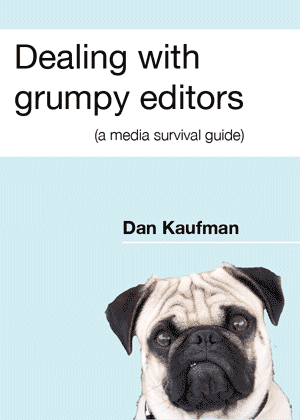
Which is where Dan Kaufman’s Dealing with grumpy editors gets its name. To public relations people journalists often appear grumpy, rude and obstructive.
This should not surprise anyone. You wouldn’t believe some of the nonsense editors have to put up with from PR people. Some of that nonsense passes for wisdom or craft in the PR industry.
Rubbish public relations
After 17 years before the editorial masthead Kaufman has seen some rubbish PR. He has also seen some sharp operators. In this book he provides practical advice for communications workers wanting to get an editor’s attention.
If you work in PR, you may not agree with everything Kaufman says. He tells it like it is in straightforward language. It is a valuable work, worth every cent of the ridiculously low $4.99 he is charging for the PDF version.
I can come to your offices – or meet you in a fancy restaurant – and give you the same advice for $150 an hour. So on second thoughts, don’t buy the book. Hire me instead.
Grumpy editors
In the spirit of good journalism, I should disclose my connection with Kaufman. I hired him as a junior journalist some 17 years or so ago. Hopefully he wasn’t thinking of me when he gave his book its title.
The ideas sketched here in 2017 largely came to pass, though not always through IndieWeb protocols. The principle—journalists owning their work and distribution—proved correct:
**Portfolio control matters: ** Maintaining your own archive became essential as news organisations collapsed and old URLs disappeared. Journalists who owned their own platforms kept their work accessible.
The subscription economy: What the IndieWeb called “owning your content” evolved into sustainable business models where journalists developed direct reader relationships. The 2017 vision was correct: independence from the big tech giants became crucial for journalism sustainability.
The view from 2017
The first and most obvious overlap between journalism practices and the Indiweb is the idea of having a syndicated work portfolio. If you like, you can create a single source, feed or river of everything written or posted elsewhere.
This means linking back to stories published on mainstream media sites. I want to do this even when those sites don’t reciprocate my links.
At the moment I sometimes write a linking blog post on my site.
Linkrot doesn’t help
One problem with this is the way big newspaper sites change URLs and even drop old content. Keeping links up to date is hard work. Publishers missed opportunities to maintain permanent archives—another reason journalists need control over their own content.
The second Indieweb idea is to somehow consolidate the comments that fill different buckets at places like Facebook, Google+ and Twitter. There are also some on Disqus.
There have been times when there are two or more conversations covering much the same aspects of a story. It would be better if the interested commenters could see what others have to say and interact.
Indieweb central repository
Then there’s my unrealised idea of moving to more of a stream-of-consciousness style of reporting. This is not so much Jack Kerouac style, but more like the daily live blogs you see on sites like The Guardian. I like the idea of writing a post then update it as the story evolves. This would be easier to manage with a central repository.
Last and not least, there’s my need as a journalist to own my work outside of the big silos.
I’m not a snob about FaceBook or Google, but I am aware their shareholders get the reward for my effort when my work appears there. It won’t happen overnight, but the Indieweb may hold the key to redressing the balance in the future. The subscription economy that emerged proved this concern valid—journalists needed to own their reader relationships, not rent them from the tech giant’s social media services.
There’s a lot to be said from taking back control over how we work with technology.
More on journalism and media:
This post is part of ongoing coverage about journalism independence, business models and platform control:
Originally published December 2011. Updated January 2026. After 40+ years in technology journalism, this principle remains central to my work.
Why detachment matters in journalism
The percentage may have changed slightly—technology has seeped deeper into everyone’s lives since 2011—but the core principle hasn’t: maintaining distance from geek culture makes for better technology journalism.
This isn’t about lacking technical knowledge. It’s about perspective. Technology journalists serve readers, not industry insiders. The moment you write primarily for other technology enthusiasts rather than the people who actually use technology in their daily lives and work, you’ve failed your audience.
I’m not comfortable when I’m with other technology journalists who want to talk about Star Trek or Dungeons and Dragons.
To say these things don’t interest me is an understatement.
We have science fiction books on our shelves at home. Visitors to our house assume they are mine. They are not. They belong to Mrs B. And apart from her reading tastes, she is even less geeky than me.
Computers do not mean geek
Most of the points I scored on the geek test come from work. After all, I’ve spent years writing about computers and technology, I know the difference between a Rom and a Ram.
Of course, I have more than one dictionary. It’s a journalist thing – they are tools of my trade. And yes, I confess I correct people’s grammar. Editing has been my job for most of my adult life.
In the past, people have commented on my non-geek status making me the wrong person to edit a newspaper’s computer pages, run a computer magazine or write about technology.
Detached
I disagree. A level of detachment means I can make better rational decisions. I’m less tempted to air my prejudices. It means I write for ordinary people, not geeks. In fact one of the skills I’m most proud of is being able to explain tricky things in plain English.
I’m a journalist first, technology specialist second. I can – and have – written about most subjects.
And anyway, most of my work has been writing for non-geek audiences. My lack of geekiness means I can better serve their needs.
This approach proved especially valuable when covering New Zealand’s technology industry. Local companies need journalists who can explain their innovations to potential customers and investors, not just other technologists. Being able to translate technical developments into business and economic terms serves both the industry and the public better than insider jargon ever could.
The same applies when covering telecommunications regulation, business model challenges in media, or the impact of technology on society. These stories require understanding the technology, but they’re fundamentally about people, economics, and social change.
My journalism training taught me to ask “why should readers care?” before “how does this work?” That order matters. Geeks often reverse it.
Journalism first, technology second
This reader-first approach shaped how I’ve covered journalism itself. When publishers struggled with digital transformation, the story wasn’t about the technology—it was about business models, audience relationships and sustainable journalism.
When paywalls and subscriptions became necessary, the challenge wasn’t technical implementation but convincing readers of the value proposition. When ad-blocking threatened publishers, it was fundamentally about the broken relationship between readers, publishers, and advertisers.
Technology enables or constrains these developments, but it’s never the whole story. That’s why detachment from geek culture remains an asset, not a liability.
More on journalism and media:This post is part of ongoing coverage about journalism practice, business models and the craft of technology reporting:
He mentions the editors' blogging and the way the BBC opened up its back-end to developers. Both matter.
His first item, the BBC’s web writing style, may prove more important in the long-term.
The organisation’s online news writers write crisp, tight news copy. They get right to the point, line up the important facts, then get out-of-the-way.
BBC learned the hard way
Bradshaw says the BBC learnt to write tight news stories when it ran Ceefax – a teletext information service which predates the internet. Ceefax allows little in the way of graphics and only 24 lines of 40 characters. Journalists had less than 200 words to tell their story.
Sharpening skills on Ceefax before the internet, gave the BBC a head start over other written news outlets which had become wordy thanks to larger newspapers.
Bradshaw says: “Even now it is difficult to find an online publisher who writes better for the web.”
The online team is even better at writing news headlines. Its editors compress the gist of an entire story into just five or six words. Most headlines fit inside that Ceefax page width of 40 characters.
Originally posted at billbennett.co.nz on Feb 21, 2011
Impressed by Simone Silvestroni’s De-brand blog post. It covers some of the things I’ve been wrestling with as a journalist.
My Bill Bennett micro.blog site was set up from the outset along similar lines. It’s hard to totally debrand the Ghost site because it’s a business. But let’s work on it.