Trying to figure out if all the Federation development that’s been going on recently means I can now follow an indieweb enabled site like boffosocko.com from micro.blog.
-
-
Unnecessary journalism phrases
The website hasn’t been updated in over a decade, yet there is still value in Unnecessary journalism phrases.
It is just what it says on the label. The website shows the wordy phrases journalists use to pad their copy.
Each phrase is simply illustrated with a handful of recent examples, mainly taken from US newspapers.
Some examples:
Never Before Lifeless body 4 p.m. in the afternoon
Before we get carried away, many journalists, including myself are paid by the word. A few unnecessary phrases will buy a cup of coffee. Write enough and you can pay off the mortgage.
-
Trolling, dumb-arsed headline questions
I’m not one for new year resolutions, but IF I had one it would be to not write trolling, dumb-arsed questions in headlines.
That said, stories with questioning headlines tend to get read more often and propagated more widely around the internet. Which is a minor moral dilemma.
Some questions are legitimate. I’d argue that
- Post-Twitter: What comes next? and
- What is going on with Microsoft Surface?
are fair enough. You’ll notice they can not be answered with a simple ‘yes’ or ‘no’.
-
On reaching my digital subscription limit
This week I had a couple of emails from Sky TV telling me the payment for Sky Sport Now has not gone through.
The wording makes it look as if the non-payment is an accident. That’s not the case. I want to put it on hold for a week or two while I take another look at my total digital subscription spending.
It’s high. Too high. But not out of control.
And it’s not out of control because I make a conscious effort to stay on top of spending on digital subscriptions.
In 2021 my annual Sky Sport Now subscription was $299. Last year I paid $399, but had a $100 rebate making it $299.
This year Sky wants $450. In effect a 50 per cent price increase.
That’s fine. I get my money’s worth from Sky Sports. Each week I watch three, four or more hours of Premier League football. If there is international cricket, football or Rugby I’ll watch that too. At times I also watch baseball and other sports.
So on a dollar per hour basis, $450 a year isn’t bad value.
It’s even better given that I no longer have to subscribe to Spark Sport as well.
Sky doesn’t seem to cover the Champions League and I can never be sure the cricket I want to watch will be shown, but these are not deal breakers.
So why haven’t I renewed yet?
That’s because I’ve set myself a hard limit on digital subscription spending and something needs to drop out before I use the debit card to pay for Sky. There are plenty of candidates. It won’t be long. And I can watch the Ireland - All Blacks game on free-to-air, so that’s not a problem.
What IS a problem is that digital subscription prices are rising faster than general inflation, while my income is not. In fact my income has almost stood still during this recent period of inflation. They may be able to charge more, I can’t.
Sky is up 50 per cent. Streaming TV prices are either up or soon will be. Software subscriptions continue to rise.
I get that companies want to use inflation as a way of squeezing higher profits. It’s not good, but that’s how it is.
Food costs more. Everything costs more. Many of those price rises are unavoidable. Digital subscriptions are, for the most part, optional. They are what economists call ‘discretionary spending’. I’m using my discretion and not spending any more.
I’ve already trimmed a number of digital subscriptions. Next week a couple more come up for renewal, but I won’t be buying them any more. I’ve reached my digital subscription limit.
-
Was confused by all the Thanksgiving posts I can see on Micro.blog until I realised that Canada has a different Thanksgiving day to the US.
Now I’m curious. Are they giving thanks for the same thing?
-
The bad times are back
For a decade I didn’t have a single bad debt for my freelance journalism and writing business. Apart from one or two minor administration issues, the average time it took to get paid was less than two weeks.
When Covid sent New Zealand into lockdown, the work slowed, but the invoices kept on being paid.
Then, about 18 months ago, I noticed customers starting to string out payments. The average payment time climbed. Soon after, I had my first bad debt in 15 years of freelancing. There have been a couple more since. The bad debts aren’t huge, but collectively they mean I’ve worked for a couple of months without getting paid.
It was worse in the early 1990s here in NZ and in the mid-1980s when I was in the UK. But either way, it looks like the bad times are back.
This isn’t just a whinge (although I accept it is a touch whingy) it’s about the wider economy. It’s about business confidence and investment opportunities.
Technically we’re not in a recession, but that’s not how it feels and I know I’m not alone. It’s what I hear when I talk to friends, my customers and my business suppliers.
-
Memo to self and anyone else who uses Apple kit:
Hang on to that USB to Lightning connector because any day now you will need to charge a device that still uses the old standard. Never mind that you haven’t found such a device yet, there WILL be one somewhere.
-
It could explain a lot if it turns out that Elon Musk has been testing his brain implant technology on himself.
-
Apple Watch has “complications”.
These are the last things I want in my life. Looking forward to when Apple Watch can offer me “simplifications”.
#Apple
-
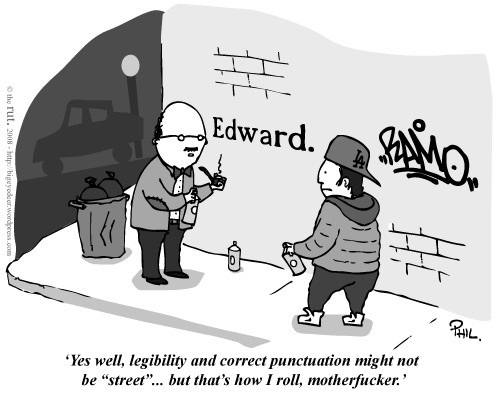
Go ahead, end a sentence with a preposition
Your school may have taught you not to end a sentence with a preposition. This is a hangover from Latin and Greek. Sentences in those languages never ended with prepositions.
Years ago I worked in communications for Britain’s Science and Engineering Research Council. My boss took me to task for ending a sentence with a preposition.
He told me it was; “Something, up with which, I will not put” – a quote from Winston Churchill.
Churchill was on my side in this. I suspect my boss didn’t realise the quote was a joke.
While the grammar police won’t agree, this is a rule you can ignore. It doesn’t apply to everyday writing, business writing, journalism and online communications.
There will be times it doesn’t make sense to twist sentences to avoid ending with a proposition. Your writing will be clearer and easier to understand.
Relax. You’ll be in great company. Most newspaper style guides allow it. Most popular authors and the overwhelming majority of modern literary authors sidestep the rule.
-
It’s old, but I love this cartoon:
-
“Mr Bond, they have a saying in Chicago: Once is happenstance. Twice is coincidence. The third time it is enemy action.”
- Auric Goldfinger
-
Went to the Ever Present: First Peoples Art of Australia exhibition at Auckland Art Gallery today.
It’s a huge exhibition, so much that I couldn’t take it all in on a single visit. Will need to go back at least once more before it closes.
Definitely recommend it. Worth travelling to Auckland for if you live elsewhere in New Zealand.
-
Google as a verb
Google is one of a rare breed of companies that has moved into everyday language as a verb.
There are language purists who argue against turning nouns into verbs.
Don’t worry. It’s fine to “google something” online. People have “hoovered carpets” for years.
Note the lower case G and H.
Most of the time Google and Hoover are proper nouns requiring a capital.
There’s no such thing as a proper verb, so why should Google or Hoover take a capital when they are used as verbs?
Years ago when I was starting out as a journalist there was a regular supplement in the UK Press Gazette which argued exactly that: a company name used as a verb needs a capital.
I wasn’t convinced then. I’m not convinced now.
-
There would be a place in Ben Werdmuller’s otherwise excellent Publishers on social media are between a rock and a hard place to mention Micro.blog.
It doesn’t drive much traffic to my website, if any… but it gives me a lot of what Twitter no longer can. Also, it meshes nicely with Mastodon.
My site traffic is down by between 20 and 30 per cent now I’m not active on Twitter. I could make a faustian pact to get that traffic back, but at least I’m comfortable with myself.
-
This would be a fascinating story to read, until you get to “Macalister was not willing to reveal the names of the 16 companies.”. At which point I lost all interest.
-
Seven things I’ve learnt about blogging
- You don’t need fancy software to blog.
- Free hosting services, like WordPress.com can as good as or better than self-hosting. You’ll need to pay for a few basics, but it won’t cost more than web hosting.
- A low-cost, minimalist option like Micro.blog (where you are reading this post) is the best for anyone who’d rather write posts than mess around with code.
- Blogging can take up a huge amount of time. It doesn’t have to.
- There’s a community aspect to blogging. It isn’t apparent until you dive in and do it yourself.
- Blogging is similar, but not the same as journalism.
- My blogs don’t have any direct economic benefits, but they keep me in touch with audiences and show prospective clients that I’m alive and kicking.
-
In the latest Download Weekly newsletter:
Vodafone FibreX party leaves One NZ with $3.7 million hangover
Newsletter is free, shown in full on-line. You can sign up to get email delivery at the site.
-
I am both impressed and intimidated by Logic Pro on the iPad. It’s everything I wanted, but it is taking me a lot of time to master the software.
-
Community hunts for origins and installer of mysterious metal pole
I’m amazed no-one has mentioned aliens. ;)
-
After Twitter
There are plenty of post-Twitter alternatives to choose from. Each of the active ones has its own charm, its own potential and its own source or sources of friction.
Yet, none solve the problem I face: my main website’s readership remains on Twitter. Web traffic has plummeted since I’ve wound down my Twitter activity.
It wasn’t too bad at first when I could relay messages from Micro.Blog or Mastodon to Twitter. Now those avenues have shut.
The next stage is going to be difficult.
-
The four most dangerous words in investing are: It’s different this time.
- Sir John Templeton, quoted in The Asian Age.
Not only are there no new economic paradigms, the moment anyone mentions the word paradigm in connection with your money, I suggest you run for the door.
-
Structure your writing like a journalist
Newspapers teach journalists to write using the inverted pyramid.
It isn’t always the best approach, but it is reliable. the inverted pyramid has worked for news writing since the days reporters telegraphed dispatches to editors. Today it works for online writing.
The structure echoes the classic essay structure you were taught — or should have been taught — at school.
The basic format:
Introduction — say what the piece is about; answer questions like who, what, where and when. You can also explain why at this point, although that can wait until later.
Then — expand, amplify;
Keep doing this until you’ve told the whole story. Make the most important points first then add more and more detail in each additional paragraph.
How did this develop? Printed newspaper had limited space for news. Traditional newspaper subeditors would cut a story from the bottom if it needs to fill a specific space on a printed page.
The inverted pyramid structure, with each paragraph being progressively less important, means editors remove the least important information first.
A news story written using the inverted pyramid structure can be cut at the end of any paragraph, even the first paragraph, and still be a self-contained story.
Online this means search engines pay more attention to the most important words – which helps people find your writing. Those opening paragraphs also make neat summaries for listings and similar online uses.
The most important information goes in the first paragraph and each extra paragraph carries progressively less weight. That’s where the inverted pyramid name comes from: the foundation sits at the top, the less important details are at the bottom.
-
Use be verbs sparingly
If you want to make your writing clearer and more interesting, use ‘be’ verbs sparingly.
The verb to be includes:
Be, being, been, am, is, are, was, were.
Be verbs make text dull partly because of overuse, but also because they remove the reader one step from the action. They take readers the long route to meaning and can be long-winded.
Compare:
Fred is dismissive of cowboy films
with
Fred dismisses cowboy films.
The second phrase has more energy, it propels the reader along. It expresses the same idea in a clearer, more concise way.
Be verbs turn up in passive language, staying away from them helps keep your writing in the active voice.
Old-school newspapers taught journalists to never use be verbs in headlines, but prefer strong action verbs instead. It’s hard to get away with that in today’s online world, so think instead of keeping them to a minimum.
-
Make the active voice your first choice
The active voice is usually better than the passive voice because it is direct. This makes it easier to understand and unambiguous. With the active voice a subject does something to an object: Andy kicked the ball.
In the passive voice the object is acted on by the subject: The ball was kicked by Andy.
An active voice makes for tighter writing and easier reading. It is more personal and less formal.
Efficient writing The passive sentence used six words while the active sentence needed only four. It has simpler grammar. Active sentences are economic and clear.
Active voice phrases are easier to understand because they involve fewer stages. Think of it as fewer mental hoops to jump through. This becomes important in more complex sentences and longer pieces of text.
While active voice sentences are also easier to write, you might not always find this in practice. The good news is that writing active sentences helps organise your own thoughts. That way you’ll write clearer.
Confident words Sentences written in the active voice read as if the writer is confident about the facts. In contrast, phrases and sentences written in the passive voice seem tentative or uncertain.
Bureaucrats and corporate managers often like hiding behind the passive voice’s ambiguities. Academics like to use it.
For example, in the phrase; “the claims have been analysed”, it isn’t clear who did the analysis. On the other hand; “We analysed the claims” is definite.
It gets worse when the writer resorts to using the word ‘it’ instead of ‘I’ or ‘we’: In the sentence “It was decided no claims would be payable” the author is deliberately hiding behind the ‘it’ implying that authority comes from on high and not identifying the person who did the deciding.
There are times when you need to use the passive voice. That’s another post