
Posted January 2023: Apple’s 10th-generation iPad updates almost every aspect of the company’s entry-level tablet. It is a better device in almost every way, but the improvements come with a higher price and a couple of awkward design choices.
10th-generation iPad at a glance
| For: | Performance, battery life, screen and screen size, speakers and camera are all improved over the 2021 9th-generation iPad. |
|---|---|
| Against: | Expensive. Bulky keyboard. Limited keyboard choice. |
| Maybe: | 64GB storage on the base model feels lightweight in 2023. Only pairs with first-generation Apple Pencil. |
| Verdict: | A great update that brings the iPad up to date. The 10th generation update delivers a lot more iPad, but comes with a significant price increase and a couple of questionable design compromises. |
| Price: | NZ$900, add $300 for a Sim slot and $300 for 256GB storage. |
| Web: | Apple |
A fresh look with familiar cues
From the outside, the 10th-generation iPad resembles a modern iPad Air. The 10.9-inch display stretches closer to the edges, replacing the older 10.2-inch screen and thick bezels of the previous model.
It looks and feels good. The design is clean, solid and comfortable to hold. Apple has also added a splash of colour, with blue, pink and yellow options alongside silver. The earlier model came only in silver or space grey.
Despite the larger screen, the tablet remains light at around 480g. It slips easily into a bag and is barely noticeable when carried on its own.
More power where it counts
The move from the A13 to the A14 processor brings a useful performance lift. On paper, it is around 20 percent faster, although most users will only notice the difference in demanding tasks such as photo or video editing.
In everyday use, the iPad feels quick and responsive. It handles browsing, writing and media consumption without effort. Even heavier workloads run smoothly.
The A14 does not support Stage Manager, Apple’s advanced multitasking feature, nor does it include hardware acceleration for video encoding. That matters more to power users than to the typical iPad buyer.
A bigger screen that makes a difference
The jump from 10.2 to 10.9 inches may sound modest, but it delivers a noticeably larger viewing area. The extra space is welcome for reading, writing and watching video.
Apple has removed the home button, moving Touch ID to the power button. The front camera now sits on the long edge, which makes more sense for video calls in landscape mode.
Battery life is excellent. Expect more than ten hours on a charge with mixed use. That drops when using a keyboard, but it remains strong by tablet standards.
Keyboard: capable but clumsy
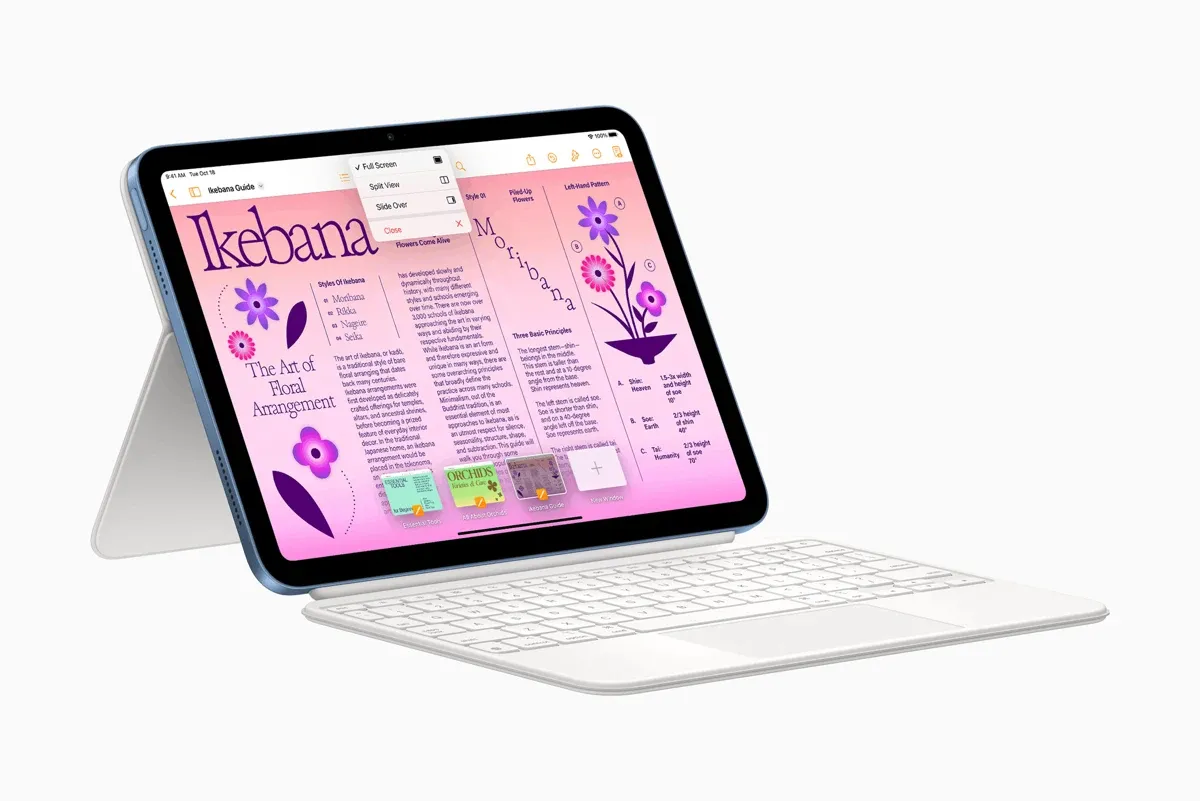
Apple offers a single keyboard option, the Magic Keyboard Folio. It connects via the Smart Connector and includes a trackpad and a row of function keys.
Typing feels good and the trackpad is responsive. This review was written on the device without issue.
The design is less convincing. It uses a two-piece layout with a kickstand, an idea borrowed from Microsoft’s Surface range. The kickstand works, but adds bulk. The keyboard itself is thick and heavy, weighing more than the iPad.
There are cheaper alternatives from Logitech, but the overall choice is limited.
Apple Pencil compromise
The iPad supports only the first-generation Apple Pencil. That is an odd decision given newer models use the second-generation version.
Charging is the problem. The Pencil uses a Lightning connector, while the iPad has USB-C. You need an adaptor to pair and charge, which feels like an inelegant workaround.
It is a rare misstep for Apple and undermines an otherwise polished product.
Price and positioning
The 10th-generation iPad starts at NZ$900 for 64GB. Moving to 256GB adds NZ$300. Cellular connectivity adds another NZ$300.
Accessories push the price much higher. Add a keyboard and Pencil, and the total climbs quickly. A fully equipped setup can exceed NZ$2200.
At that point, it overlaps with laptop pricing. A MacBook Air costs a similar amount, and for some buyers may be the better choice.
The older 9th-generation iPad remains on sale from NZ$650 and offers strong value for basic tasks. At the other end, the iPad Air adds more power, better display features and support for the newer Pencil.
Value depends on your needs
The 10th-generation iPad sits in an awkward middle ground. It is more capable than the 9th-generation model, but not as flexible as the Air.
For many users, it will be more than enough. It is fast, well built and supported by a deep app ecosystem. Apple’s long software support cycle also adds to its appeal.
The question is whether you need the extra features. If not, the cheaper model may make more sense. If you do, it may be worth stepping up to the Air.
Verdict
The 10th-generation iPad is a significant upgrade that modernises Apple’s entry-level tablet. It delivers better performance, a larger screen and improved everyday usability.
It is also more expensive and not without flaws. The keyboard design and Pencil support feel compromised.
Even so, it remains an easy device to recommend. For many buyers, it will be the right balance of performance, portability and longevity.
