_This post was originally published in September 2012, so it’s now about events that happened close to 45 years ago. Oddly, I can remember this very well, better than many recent products and launches. _
Jupiter Cantab’s Jupiter Ace has just turned 30. It is a curious footnote in the history of personal computing.
I still remember the Ace quite well, mainly because it was a quirky home computer. We called them home computers in the early 1980s, the term personal computers came later.
Go Forth with Jupiter Ace
While every other home computer used Basic, the Jupiter Ace used Forth.
Early home computers didn’t have disks or operating system in the modern sense – although you could store programs and data on cassette tape. They mainly had a version of the Basic language stored on Rom.
Basic is an interpreted language. Each line of code is processed or interpreted in turn rather than compiled into machine code. This made it slow.
We need to put slow needs in context here. The Jupiter Ace had an eight-bit processor running at 3.2Mhz. That is roughly 1000th the clock speed of a modern PC.
Forth is still interpreted, but it uses a different structure, so it is many times faster than Basic. It was designed to control radio telescopes, so it was idea for building computer controlled-projects. I had just built a synthesizer and had plans to use the Ace to build a drum machine.
However, it was harder to learn and much harder to understand. And, as I now know, I’m not geek enough for that kind of thing.
At the time a friend described it to me as a write-only-language. So the Ace was essentially a computer for serious programmers. That’s not me. I tried to get my head around Forth, but the Ace was soon in a cupboard somewhere collecting dust.
T
hanks to Liam Proven @lproven for spotting my name in The Register story.
It is one thing to speak to a microphone and one or two others in a studio. Standing in front of a crowd or on a stage is something else.
I cracked it by starting small. Try:
a small crowd,
a short talk
and an easy topic. Something you know about.
Start with a short talk to a small audience
My first official public speaking engagement was for a local computer company in Wellington, New Zealand. The company had regular evening events with food and drink for its customers and would invite speakers.
The company’s managing director asked me to talk for about 20 minutes on my work as a technology journalist. I can talk on this subject about for hours.
Thankfully, the audience was unintimidating, maybe 25 or so people and the mood was friendly, even convivial.
By the time the discussion was done, my fear was history
When I finished speaking, a discussion started which went on for almost another hour — I didn’t realise until afterwards that I had chaired the discussion keeping things moving along when it flagged. I just did what came naturally. There wasn’t time to think about what was going on. No time for nerves to kick in.
Over the next few months I had a few similar speaking engagements, the audiences remained small, but the session length and topics would be different. After around five or six events I was comfortable enough to tackle a larger crowd.
I
t took longer for the fear to reach the point where I could comfortably stand up in front of a crowd and talk, but within 18 months of the small talk, I was hired by the company that was, at the time, Apple’s distributor in New Zealand to speak in front of more than 1000 people at a major product launch.
For years I couldn’t speak in front of an audience. I was terrified.
Informal speaking to a small group wasn’t a problem. Put me on a stage in front of a crowd and I’d freeze.
My voice would crack or go up an octave. I’d be muddled, confused and unable to remember what I had to say.
If I had notes, I was too nervous to read them. It was painful. And embarrassing.
I was in my mid-20s and my career was taking off. My fear of public speaking was starting to limit my options.
Then overnight, I cracked it.
Not seeing the audience
The secret was something simple: radio.
At the time I edited a computer magazine for beginners. One Christmas, BBC Radio London asked me to come to the studio on Boxing Day to field questions from new computer owners who didn’t know how to get started.
It was something I was comfortable talking about. There were only two or three of us in the studio and it was a long session, long enough to get over my nerves.
There’s more than one type of public speaking
The show went so well, the BBC asked me back. Year-after year. Soon I was getting radio spots on stations all over the UK and national ones too. I had regular appearances on BBC Armed Forces Network and then, the BBC World Service. I was doing radio broadcasts at least once a month,
At this point I realised I was speaking to a large audience and people found what I had to say was interesting. The radio professionals told me they were getting positive feedback from listeners.
Leanpub sent email saying an updated version of Paul Bradshaw’s book Scraping for Journalists is available. The mail includes links to download the book in PDF, EPUB or Mobi formats – or perhaps all three , there’s no digital rights management to worry about.
Because the book is already purchased, updates are free.
Leanpub is a great way of selling ebooks: buy one, all future updates are free.
Royalties are generous for writers, around 90 per cent less a 50 cents per book fee.
Another great thing about Leanpub, is the books are reasonably priced. Scraping for Journalists doesn’t include as much
information as you might get from an everyday paperback, but the price is about half what you’d pay for a printed book. There’s also a money-back guarantee.
“It doesn’t matter what app it is – they all try to get me to turn on notifications, again and again, so that I can come back to their service. Facebook and Instagram are the most aggressive”.
There comes a point where notifications are counter-productive. In my case I first smelled a rat with Linkedin because of the constant barrage of notification mails. The service seemed desperate to get my attention.
Sure, there can be some notifications that should stop you in your tracks. It’s possible to allow family members or important colleagues to cut through. As for the rest… they can go
I killed my LinkedIn account. Nothing bad happened. In all the years I was a member I got maybe, one small freelance writing gig from LinkedIn. Since leaving my work in-tray is as full as it was and I’ve eliminated a time-sink.
Leaving Facebook is harder. There are people who are important to me who I’m in touch with there. The don’t seem to have any alternative online life. So the account lives, but I’ve turned off all notifications. In fact I’ve turned off almost all notifications from every online service or piece of software.
The only exceptions are where I need to react fast for business reasons. And, anything relating to my immediate family.
Here’s the thing. Nothing bad has happened. If anything I’m more productive.
Notifications are often not about serving our needs, but are about someone else’s business model.
There is also a nuclear option. Choose one day a week to turn everything digital off: have a digital sabbath.
For most of the 1980s and 1990s I was an Apple Macintosh user. I chose a Mac because of its elegance and its ability to produce beautiful print documents.
When I got my first Mac, Windows and IBM PC computers were still in the text-only dark ages.
Early Macs had another advantage. They came with solid keyboards able to take a pounding.
I certainly gave mine a pounding. Like most journalists in those days I learnt touch-typing on manual typewriters – hammering out words on slips of paper.
Like a typewriter, not a typewriter
My Mac was typewriter-like, but it followed a different set of rules to any typewriter.
I needed a guidebook to get the most from my new tool and found Robin Williams’ excellent The Mac is not a Typewriter (ISBN: 0938151312).
The book explained how to use the computer to make great-looking documents. Some tips, like not typing two spaces after a sentence, were obvious. Others were less so.
Dated
The book has dated. Parts of its content are no longer important. And some of its lessons are now second-nature to experienced computer typists.
Yet you’ll still get value from reading the book – if you can find a copy – because while we may not print as many documents as we did in the 1990s, we still create documents. And making them look good can be as important.
For example, there’s a section explaining why, most of the time, you shouldn’t use justified text. It is harder to read and large blocks of white space – known in the business as rivers – appear. They are ugly and distracting, yet you see them everywhere in PDFs and on websites.
He says digital devices with always-on connections train us to split attention between tasks without ever focusing on one.
Schwartz says this hurts productivity increasing the time to finish a task by 25 per cent.
Always-on notifications are always-on distractions
In The magic of doing one thing at a time Schwartz recommends setting aside time for what he calls absorbed focus.
Or concentration. It is an old-fashioned idea. Remove all distractions and work on a single task.
This is the opposite of multi-tasking, which is rarely a productive way of working.
Some tasks are tougher without focus
Take writing; the art of putting words on paper or on screen. It’s possible to write in a busy, noisy office. Journalists do this all the time, successful newsrooms can be boisterous places.
Early in their careers journalists learn how to achieve a short-term laser like focus. It isn’t always easy. It is harder if you need to pick your phone up every few minutes to deal with incoming calls, mails or other messages.
Get it right and you can achieve a Zen-like flow.
Start by turning off notifications. Your computer may have a focus mode. Apple Macs are good at this allowing you to switch notifications off for an hour or the rest of the day.
One advantage in the old days was that journalists hammering dozens of manual typewriters at once created what amounted to a wall of white noise.
Helpful technology
Technology can help with focus. There are distraction free writing tools. The iPhone’s silent button is a godsend.
While you can multi-task on an iPad, that is not the way it was originally designed. iPad apps lend themselves to taking over the entire screen so that you focus on a single window. iA Writer is great for doing this, but all iPad writing tools can work in a similar way.
The iPad’s self-imposed one-app-at-a-time limitation can make writers more productive. There are other jobs where having multiple windows open at the same time is essential, but you’ll focus better with just one.
Jack Vinson has another take on The Magic of Doing One Thing at a Time at the Knowledge Jolt blog. There he shares his tips on how to set aside blocks of time for intense focus.
Prices are an important part of any feature or story covering products or services. For readers the price is often the most important piece of information.
But there’s a problem with this.
Psychological pricing
Retailers use psychological pricing to trick customers in to thinking prices are lower than they are. Even if you’ve never heard the term before, you’ll be familiar with the idea.
Psychological pricing is when retailers price an item at $1.99 or another number ending in 9.
Researchers at New Zealand’s Massey University found 60 percent of prices on goods advertised in the local newspaper end in 9.
Other research shows consumers focus on the left-most digits in a price. So they think an item priced at $1.99 is considerably cheaper than one at $2 even though the real difference is just 0.5 percent. Not even that. Retailers don’t give customers change if they handed over two dollars.
To use a popular online term, this is a dark pattern. It hides information from readers.
The journalist’s job
It’s not a journalist’s job to sell a company’s product. We are not sales or marketing people.
The job is about informing readers. We aim for accuracy. And this is where some run into a problem.
Informing readers means we shouldn’t play retailers’ Jedi mind trick games. We should write $1.99 prices in our copy as $2. That’s often the amount readers will pay.
On the other hand, accuracy demands we are sticklers for detail and list the price as $1.99.
Simplifying .99 prices
There are three reasons why journalists should round-up psychological pricing.
First, while rounded-up numbers are technically wrong, if the theory of psychological pricing is correct, the way the reader understands a rounded-up price will be closer to reality. It tells the truth.
S
econd, rounded numbers are simpler. You more immediately understand what spending $2 will do for you finances than spending $1.99. The price information flows faster to the readers’ brain – this is always a key goal in journalism, we aim to simplify without dumbing down.
Third, any technical inaccuracy is minor. When 99 cents rounds up to $1, the result is 99 percent correct. With all other prices the accuracy is greater still. Rounding $9.99 to $10 is just 0.1 percent out.
Technology publications and daily newspapers are full of gushing Samsung Galaxy Note 7 reviews.
Where reviewers give review products stars, the Galaxy Note 7 either gets five or 4.5. When they give a percentage the scores are often north of 90 percent.
Glowing praise
Many of the words reviewers use to describe the phone are glowing. One phrase that pops up a lot, is best ever. Some call it the best ever Android phone. Others are more general. You might also see best phone period.
Which means reviewers like it.
But best ever?
Really?
On one level the phrase is meaningless.
Few Apple product launches pass without an executive saying a product is the best ever. You’ll see those words in the press release and possibly in Apple’s marketing.
Of course an iPad launched in 2016 is the best ever iPad. Apple would be in a sorry state if this year’s model was worse than last year’s.
Being better than last year is a low bar to jump over.
Language inflation
It’s not just Apple that talks about products this way. Everyone talks up their business. We’ve become immune to inflated marketing language.
Yet reviewers should be dispassionate observers. At least the ones working for respectable publications should be.
When they say a phone is the best ever, they appear to be passing an objective judgement. The implication is that they have seen lots of phones and of all they have seen to date, the one in question is the best.
Which it might well be.
Yet another likelihood is that the company marketing the product planted that idea in the reviewer’s head. Even the best reviewers can be guilty of parroting public relations speech at times.
That Apple logic applies to reviews. Of course this year’s phones are better than last year’s phones.
When they are not, that happens sometimes, it’s a big story.
Looked at that way, saying best ever is the same as saying new or improved.
When you see this kind of language, remember to engage your critical thinking and take it with the necessary grain of salt.
More than 20 years on, Macs and MacBooks are still not typewriters.
Yet Apple’s iPad might be.
My iPad links to an Apple Wireless Keyboard and runs iA Writer. This combination gives me the closest thing I’ve seen in 25 years of computing to an old-school manual typewriter.
For a journalist that’s a good thing.
Typewriter easy
Apple didn’t design the iPad with word processing in mind.
On its own the iPad is a poor writing tool. Although the larger on-screen keyboard makes for better typing than using a smartphone.
Yet here I am tapping away and loving the experience more than I have done since my last typewriter ribbon dried up back in the 1980s.
Have I taken leave of my senses?
Let me count the ways I love you
Three things make the iPad typewriter-like:
1. Radical simplicity.
The iPad, Apple’s Wireless Keyboard and iA Writer make for simple and distraction free writing.
There’s no mouse. That’s great because lifting hands off the keyboard to point and click is the number one cause of pain for old-school touch typists working on PCs.
Until you stop writing, the keyboard controls everything.
At the same time, the crisp serif text on a plain screen is the nearest thing to a type on a sheet of paper. Wonderful.
2. Text editor
iA Writer is a text editor. Not a word processor.
There’s nothing dancing on my screen. No pop-ups, no incoming email. At least not the way I’ve set things up.
It is just me and my words. The only word processor-like feature is the iPad’s built-in spell checker, which mainly stays out of the way.
Best of all, iA Writer doesn’t do page layout. I don’t care how my words look because I can’t tinker. That’s one less thing to worry about.
This all adds up to fast, productive writing.
3. Quick on the draw
Typewriters don’t need to warm-up, to boot or load applications. Nor does the iPad.
My normal morning practice with a laptop was to make a cup of tea while waiting for the PC to be ready for writing. The iPad is ready in seconds.
I can get my thoughts down while they are still fresh. The first 100 words or so are nailed on the iPad before I’d get started on the PC.
The best computer bits are still there
While my iPad writing combination kills the bad stuff about word processing, it keeps the best feature: The ability to go back over copy and make corrections. This was always a pain when using a typewriter.
And I send my writing to just about anywhere in the world in a matter of seconds. Try doing that with a real typewriter.
Other iPad typewriter plus points
My iPad and keyboard are a lot easier to carry than my ageing and neglected portable typewriter – and easier than my laptop.
The battery life is long. I can work a whole day without needing to find a power point.
iA Writer uses cloud storage. You can choose DropBox or Apple’s iCloud. This means my work is available to me on any computer anywhere in the world.
The Mac still might not be a typewriter, but the iPad does the job.
PR and marketing people hate it when journalists describe products as ‘cheap’. We get phone calls asking us to change the word to ‘budget’ or ‘affordable’.
That’s because while ‘cheap’ means you can get something at a low price, it has a secondary meaning where the word can be used to mean ‘inferior’.
It’s not as though ‘budget’ doesn’t have a similar implication when the word is used as an adjective. No-one thinks a budget airline is going to deliver a good experience.
Oh yeah?
There’s a “says who?” problem with ‘affordable’.
That $3000 laptop might be affordable to a marketing manager. A bus driver or nurse might not consider it affordable.
Journalists should not use words like that. There’s a risk of making readers feel bad about themselves. There’s a danger we’re acting as unpaid promoters when using the language of marketing.
We’re not perfect. I searched my site and found I have used the word 40 times over 13 years and 1500 posts.
In many cases the word is a quotation.
Guilty of using cheap
Yet, your honour, at times I’m guilty as charged.
I’ve used ‘affordable’ at least a dozen times without stopping to think there could be readers who don’t agree with that word choice.
The same logic applies to the word ‘inexpensive’. My inexpensive might not be your inexpensive.
Much of the time journalists use words like ‘cheap’ or ‘affordable’ to contrast with ‘expensive’ or ‘unaffordable’.
Now there are two words that would get a marketing person annoyed if they appeared in a story about a product.
Although not always. The Samsung sales executives showing off the company’s folding phones a year ago were happy to position the product at the premium end of the range. A high price can be a marketing strategy.
As can ‘cheap’. Yet for some reason marketing people prefer that we don’t mention that.
A basic media guide for people who may find themselves suddenly thrust into the spotlight on behalf of a company or organisation.
Companies and organisations still need to keep media communication channels open. That way they get to tell their story. At the same time investors, business partners, employees and customers stay informed.
Sure, these days they can use more direct channels to reach these groups. They can control messages in direct channels.
That’s not always the best way to tell stories and it doesn’t necessarily have as much credibility as when that message is filtered through an independent outlet.
When news comes to you
And there are times when the media comes knocking on the company’s door.
You might think you don’t need to worry about any of this because your job puts you in a back room role you don’t need to worry about communications. You may work for a company that thinks it has watertight external communications strategies. Or that the company employs professionals to do all the communication heavy lifting.
Yet even if your employer has access to the brightest and best communications experts, you can still find yourself acting as spokesperson.
A credible, knowledgeable voice is powerful communications
Let’s redo that last sentence: If your employer uses the best communications experts, you are even more likely to find yourself in the media front line.
That’s because experienced journalists see through the platitudes and feel-good nonsense spouted by corporate spin-doctors.
Journalists may not immediately be able to dig deep enough to find the real story behind a smokescreen, yet they know what a smokescreen smells like.
Putting genuine, but trained and fully briefed, voices in front of the media works to a company’s advantage.
The best storyteller
A communications professional is not always the best spokesperson. There will be times when someone with deeper knowledge or experience is a better storyteller.
In extreme cases you can be forced to speak to the media even if your employer prefers you to stay in the background.
All of this means that being able to articulate a company’s position is a key skill.
Crisis management
Dealing with communications when things go wrong is known as crisis management. Smart firms put crisis management plans in place long before any problems, anticipated or not, arrive. This saves valuable time when troubles appear.
Developing a crisis management plan is best left for another time. The key elements are establishing lines of communications and putting the right people in place who can articulate a company’s point of view to the media.
Which means it is a good idea to give all senior managers media training.
Let’s assume for now you don’t have media training, there are no well-developed lines of communications and you know nothing of any crisis management plans. Things have gone badly wrong and you are in the thick of it.
What should you do if a journalist quizzes you about a potentially damaging news story?
Good stories, not good news
Before we go any further, I have skin in this game. I am a journalist, I cover business and technology, I write news. I like to write good stories.
Good doesn’t necessarily mean positive from the company or organisation’s point of view. The news media likes stories with reader interest – from your point of view that might be anything but good.
I prefer to go straight to the most obvious news source – the man or woman in the department dealing with the matter – and ask direct questions.
Getting to the bottom of the story
The idea isn’t to catch someone out or make someone look stupid—Ok. We all know there are some journalists who do operate this way. Dealing with them needs another post – the goal is to get to the bottom of the story, find facts and cut through the spin.
This was how it always worked when I was a young journalist. We would keep extensive (paper) contact books of key names in organisations to call when a story broke and to call every so often when canvassing for potential stories.
These days most employers expect employees to take one of two courses of action. They might prefer it if the employee said nothing, refuses to speak and blocks all questions.
Or they might expect an employee to tell outright lies. More likely this is never explicitly asked of employees, but people working in companies tend to know by osmosis if they work for bosses who expect them to lie.
Both courses of action are equally damaging, both to the company and to the employee.
Telling lies is dumb
Aside from any ethical considerations, telling lies is just plain stupid.
Sooner or later the truth will emerge and you will be on the record as a liar. Your employer won’t look any better.
You might get away with this. A future employer will not know, not care or may even be impressed you lied to cover your previous employer’s backside.
Maybe.
Other people will remember your lies. And that will harm your reputation over the long-term, maybe even your business.
Liar, liar
More to the point the journalists you lied to will know you are a liar. And their colleagues do. Journalists move around between companies, pretty soon most people in the media will know you are a liar.
At any point a rival might remember those lies and make them public. Your lie might be legally actionable. But even if it is not, it gives your competitors powerful ammunition the next time you want to say anything in public.
Blockheads
Blocking questions can make things sound worse than they are.
It can mean you or your employer don’t get an opportunity to put the record straight at the earliest opportunity.
There are worse possibilities.
Suppose you were to read in a newspaper, ‘company X refused to comment on claims that it was trading while bankrupt’? What does this make you think about the company?
Over the years I’ve come up against more advanced forms of blocking, but they all amount to the same thing. ‘The executive responsible for the exploding television monitors could not be contacted yesterday’ does not make the company sound innocent.
What to do when the media calls
Rules number one, two and three are do not tell lies.
Don’t even consider it. It is better to say nothing.
If you don’t want to answer questions or are not authorised to speak, find someone else who can.
There’s nothing wrong with telling a journalist that you aren’t able to help with enquiries but your immediate boss can. Make a joke and tell them is above your pay grade. That’s acceptable so long as someone higher up the tree does speak to the press.
Journalists don’t tend to ask trick questions, but it pays to listen carefully to the exact form of their question and attempt to hear what is not said. Most journalists have excellent listening skills. Some of the best industry interviewees are the same.
Pushing the pause button
There’s also nothing wrong with telling a journalist that you, or whoever can speak, is busy but will call back shortly – when you do this, calling back quickly is important. Keep their deadlines in mind.
This approach can buy you time to think about exactly what to say, check facts, workshop ideas with colleagues or warn the boss. Then take a deep breath and calm those nerves before calling back.
At this point you might even want to take advice from a communications professional. It’s not unusual for a journalist to call an executive with a question, get a pause, then hear back from a PR manager or someone in a similar role. It’s not as good as getting information from the horses’ mouth, but it’ll do.
Media Toolkit: Understanding the News Cycle
For deeper insights into how the media functions, how spin works and how to read between the lines of industry reporting.
It’s not hard to understand why public relations companies push clients to respond to negative news stories. Yet responding may not always be the best strategy.
Apart from anything else, PR firms bill clients for hosing down bad reports. A response means more business for them. A crisis can be lucrative.
From their point of view, it can feel as if responding to a bad news story is when they earn their money. In a bigger firm, the senior practitioners – which can mean higher charge out rates – often step in to take charge of the issue.
PR companies rarely have difficulty persuading companies to respond to bad news. Spirited defence is hardwired into the DNA of most companies operating in Australia or New Zealand.
But response isn’t alway the best strategy.
A bad story may not a crisis
A bad or embarrassing story isn’t necessarily a crisis. Often these things blow over and are quickly forgotten. Journalist are quick to move on to the next story.
Companies often make matters worse by overreacting and generating fresh publicity. That carefully worded response reminds people of something bad they had already dismissed.
It can breath new life into the negativity. That bad story stays in the news cycle for another day.
That can lead to the temptation for another response and the story cycle lengthens.
Know when to shut up
Some responses use such insincere language, that people who had previously given the company the benefit of the doubt may rethink their take on events.
There are times when a poor response can turn a minor upset into a crisis.
Even a well thought-out, sensitive response written by the smartest PR professionals can blow-up or be read the wrong way. Often PR responses are clumsy. They can open fresh channels of attack.
Each case is different, but there will be times when the best strategy is to shut up. Let the news cycle play out.
This post was originally written in 2008, hence the mention of Blackberrys. It’s just as relevant in 2026.
Any fool can write a good press release that hits its target audience and creates an impact.
Writing one that fails means work. There are people who have mastered the art.
As an editor I’ve seen some great efforts over the years. I’d like to share them with you.
Here are my top ten tips for making sure press releases get minimum attention:
1. Cripple its chances of reaching editors and journalists
Everyone can read plain text messages in the body of an email. The message will almost certainly get through to any kind of desktop email clients, all flavours of web mail, as well as Blackberrys, iPhones and Palm Pilots.
To reach less than 100 per cent of your potential audience, try putting some of these clever barriers in the way.
Attachments are an effective way of cutting down the reach of your press release. People reading email on mobile devices have trouble reading them. Spam filters treat them with suspicion and if you’re lucky the recipient may use Lotus Notes or some other arcane technology as a client and have difficulty decoding the attachment.
Another advantage of attachments is that you can trim your audience further by using difficult-to-open file formats: such as the new .docx file format used by Word 2007 – many journalists will struggle to read them.
Attachments are also great for bulking up the size of your release so it won’t squeeze through email gateways. If you’re clever, use high-resolution logos in, say, your Word attachments. These add nothing to the press release but can swiftly push the file size over the email gateway threshold.
A further reason for sending a press release as an attachment is its invisibility to email search. So, when a journalist finally decides to look for your press release among the hundreds and thousands in their email in-box, it will be difficult to find.
2. Minimise relevance
One way to make sure your press release fails is to make sure it has no relevance to any sane audience. For example, if you are a technology company and you buy a new fleet of cars you can squander your PR budget and make sure any future release goes directly to an editor’s recycle bin by sending the story to the technology press.
3. Send your press release out whenever
Timeliness is everything. So send releases out when you feel like it to boost your chances of failure. Better still, for print publications try waiting until five minutes after the final deadline. For online publications, wait until the story has already broken elsewhere. Editors love that.
4. Organise schedules so contacts are unavailable for interview
Good journalists are annoying creatures. Rather than printing your press release verbatim and passing the contact details over to their advertising departments, they may want to speak to the people mentioned in your releases.
A tried and tested technique for avoiding these complications is to send the people overseas shortly after dispatching the release. International communications are good these days, so just packing them off to a partner conference in Atlanta isn’t good enough, you need to make sure they are on an 18 hour trans-pacific flight or, better still, holidaying on a remote island.
5. Use poor writing skills
Obvious when you think about it. If your writing is poor and confused so that editors and journalists can’t understand your message you kill two birds with one stone.
First, you’ll make sure the first message gets spiked in the too hard basket.
Second, as a bonus, you can establish your reputation as an illiterate idiot that isn’t worth bothering with under any circumstances. That way, your future releases will go straight to the junk pile without even being read.
6. Try bullying
Sadly this powerful technique is underused. By threatening to talk to a journalist’s editor, or an editor’s boss about their poor response to your press release you can permanently undermine your relationship with scores of people (remember journalists talk to each other so this is an efficient way of burning lots of bridges).
Another approach is to tell the journalist the company in question is advertising in the publication thus triggering their professional editorial independence.
7. Don’t bother with press release photographs
Journalists and editors like photographs. They love good photographs. By making sure they are no photographs of any description you’ll increase the chances that your press release is regarded as useless.
If you think that’s taking things too far, try sending out crappy, unusable photos. Photos with dozens of un-named people work well in this respect. Getting people to hold champagne glasses, stand in front of company logos, gather around an unreadable normal-size bank cheque or impersonate public enemy number one mug shots are all effective techniques for creating instantly ignorable press release photographs.
8. Send it to everyone regardless
This is a great way to upset journalists and degrade both your personal and company reputation. At the same time if you work for a PR agency you can bill the client heaps for having a, er, comprehensive, mailing list and then bill them for time as you and your staff spend all day on the phone dealing with angry editors.
9. Keep your press release as dull as possible
Journalists prefer interesting stories. Public relations professionals recognise this and use clever tricks like passive sentences, boring ideas, irrelevant background facts, tired clichéd adjectives and implausible anodyne quotes to turn them off and help speed their press releases on their way to the great recycle bin in the sky.
In-house and government public relations people are usually better at delivering boring releases than agency staff – if you’re worried your writing sparkles too much, they have much to teach you.
10. Make sure the subject line obscures the message
Even experienced public relations operatives can slip up by giving an email release an interesting subject line. The danger is that after putting in all the hard work required to guarantee nobody takes the slightest notice of their press release they use active language to put a relevant, timely subject line message that tempts editors and journalists to open the document and read more.
The good news is there are fail-safe subject lines that are certain to turn off editors and journalists so they can just skip past your release. A classic subject line like press release will probably work, if that’s too simple try **important press release **or important press release from Company Name.
A neat by-product of badly written subject lines is they can fool spam detection engines into rejecting a message altogether; phrases like important announcement from Company Name or message for Clark Kent can come in handy here. Going straight to spam is the most efficient way of making sure your press release fails.
Want to guarantee journalists ignore your follow-up emails? Start them with “Good morning” so your message looks thoughtless when it arrives at 3pm, or worse, when they read it at 11pm while catching up on email.
Use time-appropriate greetings if you want to look professional. Or don’t, if your goal is to signal that you haven’t thought about the person on the receiving end.
I don’t understand why PRs give editors exclusives – because for the most part it does the PR and their client more harm than good.You see, if a story is newsworthy then it’ll run anyway – and if it isn’t then giving it as an exclusive isn’t going to make much difference.
Kaufman goes on to say if a PR person gives an editor a decent story as an exclusive, it will upset other editors. He says piss off, but this is a family website.
This happens all the time here in New Zealand. The practice is counter-productive.
It can certainly destroy trust a PR person or company has built.
Exclusive… oh yeah?
Waking-up, reading a so-called exclusive story then later in the day getting a press release covering the same ground happens too often in New Zealand.
Often this happens when a public relations person thinks they might get sympathetic or splashy coverage of their story if they play favourites.
PRs have approached me offering to trade an exclusive for a favourable position: often the cover of a print title. They may even ask to vet the copy in return for the story. This, in effect, can mean an editor enters into a conspiracy to mislead readers.
Many ‘exclusives’ are rubbish stories
Often stories ‘leaked’ this way are rubbish – they read more like advertising than news. Editors giving the press release an early run are manipulated into becoming part of a marketing exercise.
My response to this is to stop trusting the PR person behind the leak. This means they’ll have difficulty slipping any of their future propaganda past me. In extreme cases I’ve ignored any further communication from the source. And I’ve been known to make a formal complaint to the client. In one case I had to tell a PR’s other clients I could no longer work with their agent.
And anyway, if a company thinks it is that important to get their message in a publication they should look at advertising.
If journalists do respond to your press release, make sure you know how to handle their questions professionally:
Modern public relations people often don’t understand how the media works. Many don’t get journalism.
This wasn’t a problem in the past when most PR people were ex-journalists. Today, many publicists have never seen the inside of an editorial office.
Or if they have, they haven’t seen how editors and journalist work. They know little about what makes journalists tick. What motivates and drives reporters and editors.
Harmful PR failures
As a result many PR people end up harming their client’s chances of getting publicity. Or at least the right publicity. Instead they get in the way of journalists and annoy editors.
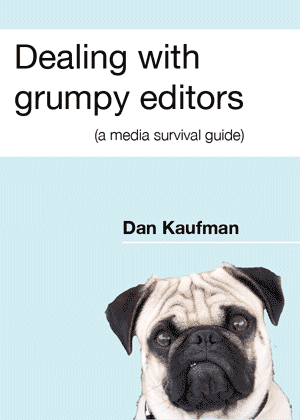
Which is where Dan Kaufman’s Dealing with grumpy editors gets its name. To public relations people journalists often appear grumpy, rude and obstructive.
This should not surprise anyone. You wouldn’t believe some of the nonsense editors have to put up with from PR people. Some of that nonsense passes for wisdom or craft in the PR industry.
Rubbish public relations
After 17 years before the editorial masthead Kaufman has seen some rubbish PR. He has also seen some sharp operators. In this book he provides practical advice for communications workers wanting to get an editor’s attention.
If you work in PR, you may not agree with everything Kaufman says. He tells it like it is in straightforward language. It is a valuable work, worth every cent of the ridiculously low $4.99 he is charging for the PDF version.
I can come to your offices – or meet you in a fancy restaurant – and give you the same advice for $150 an hour. So on second thoughts, don’t buy the book. Hire me instead.
Grumpy editors
In the spirit of good journalism, I should disclose my connection with Kaufman. I hired him as a junior journalist some 17 years or so ago. Hopefully he wasn’t thinking of me when he gave his book its title.
Although original ideas occasionally slip through the net, they generally follow the same pattern:
Headline. Should, but often doesn’t, include the most important or newsworthy point. Many press release writers waste this opportunity.
Optional second deck. Another chance to miss making the most important point. It can add facts to the headline or expand the scope of the story. A busy editor may not read past this deck, if you haven’t got them by now you can go home.
Opening paragraph. A good press release encapsulates the entire story in the first paragraph. Some do. Half the time it will waste valuable first paragraph words claiming the company is a leader or even a world leader in its field. Nobody cares.
Banal first quote. Almost inevitably the first quote is from the most important person at the company paying for the press release – possibly the person who signs off the public relations invoice. As a rule the first quote is instantly forgetable – most editors will immediately strike a line through it. It will generally be a variation on the theme of “we are so damn clever”, “we worked hard” or “we’re better than everyone else”. Nobody cares.
Optional. Press releases often use the third paragraph to waffle about something of no interest to any sane person.
Facts. If you’re lucky, the next few paragraphs will include facts. Don’t hold your breath.
Quotes. Next come quotes where people are in danger of saying something worthwhile or interesting – note this is also optional. Too often the quote read like they were workshopped by a team and use language no human would speak.
Partners. The press release then moves on to quotes from people who have important business relations with the company paying for the release. They can be interesting, but I wouldn’t bank on it. Most of these comments are bland and meaningless. It’s all about getting your mates into the story even if they don’t deserve a mention.
Important stuff. If the press release is about a product, there may be price and availability details at this point. On the other hand there may not.
Ridiculous big noting. Press releases often end with unrealistically positive paragraphs explaining how the company would like the rest of the world to see it.
At times it feels as if public relations people want their press releases to fail.
Bad press releases are a public relations own goal
“News releases became an anachronism. Online news portals and email killed the underlying functionality of paper releases as a news dissemination tool. The internet delivered news faster, and this was a good thing.”
Andrew says public relations will cease to exist as a profession and as a function.
No big deal, you may think. But Andrew works in marketing and worries press releases and similar communications will come to reflect poorly on the companies paying for these services.
I wrote this for the Sydney Morning Herald in 2007. It’s now a piece of history.
If smartphones haven’t killed off traditional handheld computers yet, the day can’t be far away. Sales of non-phone Palm and PocketPC devices are stagnant or falling. There’s been nothing much in the way of new hardware for a couple of years.
Sure, but something huge was on the way.
This is a pity. I’ve found my $500 Palm T|X to be one of my most productive tools. It goes way beyond managing my contact file and calendar information.
My word, what low expectations we had in those days.
The T|X has a 3.8 inch 480 by 320 display. While you wouldn’t call it large, it’s half as big again as the screen on most smartphones.
But tiny by today’s standards.
It makes reading text, browsing web pages, viewing photographs and even watching movies a better experience than squinting at a smartphone display.
Which was true at the time.
The 128MB of built-in memory doesn’t sound much by today’s standards, yet I’ve got a dozen or so applications running on my handheld and scores of stored documents. If I need more memory, I simply slot in an SD card.
That sounds even less now.
And we’re not talking about any old documents. The T|X comes with a bundled version of Documents To Go, an application that allows you to read and, in a limited way, edit, Word or Excel files. It can also be used to read .pdfs, making it the nearest thing to an electronic book.
OK, this looks a bit daft today, but at the time the T|X was a realistic ebook reader.
The T|X’s best feature is its built-in WiFi. When I’m travelling around the city, I stop for coffee where’s there’s a free hot spot and catch up on emails. Sure you can do this anywhere with a smartphone – but the bigger screen makes a difference.
WiFi is still wonderful.
I use WiFi to sync my Palm with my desktop before leaving home and then reverse the process when I return.
This was a novelty.
The T|X isn’t perfect, text entry is clumsy and the battery won’t make it through an extended working day if the wireless is switched on. Yet, all-in-all, it manages to better the specification of smartphones in most departments. When I’m on business away from home I carry a smartphone and a T|X.
No doubt a phone manufacturer will marry the features of the T|X with a smartphone before much longer – judging by the announced specifications Apple’s forthcoming iPhone could get there first.
Sir Clive Sinclair, the inventor and entrepreneur who was instrumental in bringing home computers to the masses, has died at the age of 81.
His daughter, Belinda, said he died at home in London on Thursday morning after a long illness. Sinclair invented the pocket calculator but was best known for popularising the home computer, bringing it to British high-street stores at relatively affordable prices.
Many modern-day titans of the games industry got their start on one of his ZX models. For a certain generation of gamer, the computer of choice was either the ZX Spectrum 48K or its rival, the Commodore 64.”
My first brush with Sinclair was as an A-level student in the UK. Before he made computers, Sinclair designed a low-cost programmable calculator.
It fascinated me and, thanks to a well-paid part-time job, I managed to buy one. From memory it could only handle a few programmable steps, but it was enough to make complex calculations.
My second job after university was working as a reporter for Practical Computing magazine. I started in January 1980 and quickly became familiar with the original Sinclair ZX80 computer.
Later that year I went to the launch of the ZX81 and met Sinclair for the first time. Over the next few years he became a familiar face.
That modest, clunky ZX81 computer changed everything. Before 1981 was out, the publishing company I worked for started Your Computer magazine which focused on small, low-cost home computers. For the first few issues I was staff reporter on both titles.
The next two years were a wild roller coaster ride. An entire industry emerged and I was in the centre of it.
ZX Spectrum was Sinclair’s definitive product
For me, Sinclair’s most important product was the ZX Spectrum. It was flawed in many ways, but it could do enough to spawn a generation of entrepreneurs and get thousands of young people into computing. I still have one in my attic.
By the time the later Sinclair QL appeared, low-cost computers with decent keyboards and storage were pushing out the minimal, low-cost options Sinclair specialised in.
By now Sinclair was Sir Clive. My last brush with his business was the ill-fated C5 battery powered vehicle. It failed and Sinclair faded from sight, later the remnants of his computer business were picked up by Amstrad.
My main memories of Sinclair were his enthusiasm and his ambitions to build devices that anyone, regardless of budget, could afford.
While flawed, the hierarchy of needs is a starting point. Managers often don’t get past first base when it comes to thinking about why people do things.
We all owe Maslow a vote of thanks for getting bosses to think about these things.
Maslow says people attend to basic needs first. They then progressively deal with more complex matters until they reach a point he calls self-actualisation. This sits at the top of the hierarchy’s pyramid.
Not everyone gets that far in life.
Maslow’s crude assumptions
The theory makes crude assumptions that don’t apply to everyone. It is simplistic. The hierarchy of needs is a blunt instrument. A one-size-fits-all solution for a complex problem.
There’s a reason for that. Maslow’s idea belongs to a time and place.
Maslow was American. He first suggested the hierarchy in the 1940s. The ideas are specific to America’s individualist culture. America was rich and everyone’s lives were improving.
I
n America’s individualist culture middle-class people worry about their personal needs more than any collective needs. It’s all a bit “me… me… me”.
Beyond the individual
He makes no allowances for parents worrying about children or workers being concerned about colleagues.
All-in-all Maslow offers a one-dimensional view of how people think and behave. It’s a first approximation, not a finished story.
Even if Maslow’s hierarchy of needs is wrong, it has value. That’s because it teaches managers that looking into people’s motivations is important.
T
oo often managers treat people as if there are no external forces driving them. For some managers, even thinking about people’s motivations is a foreign idea.
Putting motivation back on the agenda is a starting point for other insights.
I wrote this post in 2009 when spending one day a week offline was far less challenging than it is today. These days I might only get a day away from all digital screens every month or so.
Here’s the idea:
Set aside one day a week when you don’t switch your computer on.
A day when you don’t check mail, update Facebook or tweet.
No firing up the desktop for game playing.
It doesn’t need to be the same day every week. You may have to trim things according to needs and deadlines. You may only be able to manage one day a fortnight.
Go off-line and let the brain rest. Or, if not rest, allow it to change gear.
Take a break instead of constantly responding to incoming messages. Just let them pile up.
There’s always tomorrow.
You can de-stress. And before you say you find it stressful not being in constant touch with cyberspace, think again. You know that isn’t true.
The online world will go on without you.
Read books, chat to friends, play sport, enjoy the sunshine or bake muffins instead.
That way, when you get back online, you’ll be refreshed. It is like a mini holiday. It may sound like a cliché, but I work better after taking a day-long break from my computer.
Digital sabbath not original
The digital sabbath is not an original idea. If you are religious, the first sabbath came at the end of the first recorded week. The Biblical creation story says God rested on the seventh day.
Ancient Jews worked for six days then strictly observed the Shabbat when many everyday things were not allowed. They knew this was mentally and physically healthy.
I
first heard about the idea of a digital sabbath in an online forum – sadly I don’t recall who or where the original idea comes from.
Problems
It is harder to take even one day’s rest from the digital world if you have a smartphone, an ebook reader or if you use the computer as an entertainment hub for music and video. And you may have a job, or some other responsibilities that make going off-line difficult.
Nevertheless, I suggest you do what you can to give it a try, reconnect once a week with the analogue world.
I’m not perfect
I’d like to report I take a full day away from my computer every week. The truth is, I don’t always manage it. Although I try to schedule a full day off each week, I generally only get a couple of full-blown digital sabbaths each month.
Alan Sugar went on to become Lord Sugar and host of The Apprentice. Amstrad was eventually sold to BSkyB in 2007. This 2010 review examines both a book about Sugar’s early success and the British class attitudes that held back UK technology companies.
Amstrad was one of Britain’s brightest retail electronics businesses in the 1980s. During a time when most British electronic companies suffered setbacks, Amstrad’s annual profits grew from £1.4 to £160 million.
Founder Alan Sugar was rated among the country’s top entrepreneurs. What made Amstrad great and what makes Alan Sugar tick?
Sadly, these questions are not answered by David Thomas’s book The Amstrad Story.
Thomas’s omissions do not make the book worthless. It has the three i’s required of any lightweight business reader it is:
interesting,
inspiring and
informative.
Flawed Amstrad textbook
Despite its inspirational qualities, the book is flawed as a textbook for budding Sugars.
It offers no insight into Amstrad’s recipe for success. It offers no insight period. The book chronicles Sugar’s business activities with anecdotes and comments from Sugar and his business partners.
Part of the problem is Sugar’s reluctance to open himself up to public scrutiny. The man has a well-known dislike for journalists and likes to keep his personal life to himself.
As a journalist on the Financial Times, Thomas somehow managed to bypass this obstacle and gain access to some of Sugar’s thoughts and a great deal of the more favourable aspects of Amstrad’s growth period.
Puffery
Yet, for the most part the book reads like public relations puffery. Alan Sugar vetted it before publication. Only Thomas’s insistence on recording Sugar’s bad language verbatim saves it from reading like Pollyanna.
At no point did Thomas talk to any of Sugar’s rivals — he offers no critical analysis of Sugar or Amstrad.
Sugar interesting, no saint
As a journalist working in this area through most of this period in the UK, I knew of many who had much to say about Alan Sugar that was far from complementary.
Criticism, constructive or otherwise, does not diminish Sugar’s achievement. It helps us understand it.
In particular, the book does not tell us enough about how Sugar started.
It seems he left a warehouse one day with a van full of electronic goods and returned that night having sold the lot — I’d love to know how.
Shady? Who knows?
By not telling us the whole story, Thomas leaves readers with the impression there might be something shady in Sugar’s early business dealings. That isn’t fair on the readers and it isn’t fair on Sugar.
The most galling feature of this book is its Cambridge-educated author’s habit of painting Sugar as a Del-Boy or Arthur Daley-type character. Why Sugar’s design notes are reproduced along with spelling errors is beyond me.
English snobbery
The same goes for verbatim quotes complete with bad grammar or foul language. It is as if the author admires Sugar’s gumption and business brain but has to show him up as being an ignorant lout at heart.
This Del-Boy theme repeats elsewhere and it stinks of the worst kind of British class prejudice. It is a reminder of why British industry is in decline. While other nations venerate people who create new wealth the British prefer to venerate those whose ancestors made it.
Unintended revelations
Perhaps in this roundabout way the author unwittingly pulls back the curtain to show what drives Sugar: a wish to succeed and prove himself the equal or better of those born to a higher position.
If making money is a way of measuring these things, Sugar proved himself.
Despite these criticisms the book has value. The stories of how Sugar planned his computers and how he eventually acquired Sir Clive Sinclair’s business are both worth reading. Amstrad was the last major UK computer maker to capture consumer markets.
Sugar’s ability to cut through distractions and get straight to the point — usually money, is spellbinding. And those nuggets of Sugar’s managerial wisdom that peek out from underneath are pure gold.
Abraham Maslow’s **hierarchy of needs **first appeared in 1954. The world has changed enormously over the past 55 years and critics have challenged Maslow.
Maslow’s hierarchy is often shown as a pyramid. There’s an implication people move up the pyramid as their lives improve.
For an example, over time a knowledge worker will gain skills, win responsibility and in turn earn extra income taking care of the lower levels of the hierarchy.
Self-actualisation is the prize
According to Maslow this makes it possible to move up to self-actualisation – a kind of western nirvana.
Today’s global financial crisis means many workers are moving in the opposite direction.
Being laid off is traumatic. In some cases people can be at the pinnacle of the hierarchy one day and slide all the way to the bottom the moment the pink slip appears. Finding food, shelter and warmth is suddenly the most important thing on the agenda.
Doing it over again
Of course many redundant workers pick themselves up and climb back up the pyramid. The journey is easier the second time around. Knowing the route and recognising the landmarks along the way helps.
Up to a point Maslow’s theory works well enough on the four bottom stages. You only have to look around and you will see people at each level. And occasionally you’ll notice people moving up or down in a grim version of Snakes and Ladders.
You don’t see so many self-actualised pyramid toppers.
Even in the good times before the economy nose-dived, Brahmins were thin on the ground. This would be especially so in the higher echelons of the economy (which is where you might expect to find them given the pyramid). Smug, self-satisfied bastards were everywhere, but they’re rarely what you’d call self-actualised.
What does this tell us?
Maslow’s hierarchy is a useful theory, but it’s not a pyramid. It is a four step ladder. And each step up the ladder links to slides that will take you back down again. In other words, a game of snakes and ladders.
It’s an oversimplification, but Maslow’s Hierarchy of Needs says that you can predict how people will behave by looking at their underlying needs. Maslow believed a starving person would find food first, putting aside every other consideration, including social niceties.
Maslow’s theory has its uses. Yet most modern management experts and psychologists regard it with suspicion. One criticism is that the hierarchy of needs doesn’t take into account acts of selflessness, bravery, charity and heroism.
You might ask yourself why some German citizens hid Jews from the Nazis. Or why starving soldiers in Japanese prisoner of war camps would give up their own food to help the weak and dying. But then most economists and biologists would also find what look like irrational acts hard to explain.
Painters starving in attics
Likewise, many of the best and most creative painters and poets – who Maslow would describe as self-actualising – were in fact starving in attics when they did their best work.
Where does Vincent van Gogh sit on the hierarchy of needs?
And we can all think of examples of filmmakers, musicians and other artists whose creativity dried up when they hit the big time. Years ago I worked as a music journalist. I found that many rock bands would deliver a brilliant first album, score a huge contract, then wallow self-indulgently in the studio for album number two. Many never got the opportunity to make a third record.
Jim Clemmer and Art MacNeil make an important criticism of Maslow’s Hierarchy of Needs theory in their book “Leadership skills for Every Manager” (ISBN 0861889630). The book is out of print. But you may find a copy of it in a university library.
Spiritual dimension
Clemmer and McNeil suggest Manslow misses the point because he left people’s spiritual dimension out of the picture. They say that humans look for meaning in their lives. That meaning transcends any animalistic drives. In their words, “even starving people are not immune to the lure of higher values.”
Think of van Gogh.
A more scientific criticism was published in the 1977 edition of the learned journal, “The Annual Review of Psychology”. Here, A.K. Korman, J.H. Greenhaus and I.J. Badin say there’s no empirical (that is, researched) evidence to support Maslow’s ideas.
In fact, they argue, the empirical evidence points in the opposite direction. Other critics point out that Manslow came up with his theories after observing only a handful of people and it lacks scientific rigor.
Originally posted February 2009
We’ll leave these debates for the academics.
The important thing about Maslow’s idea is that it is a good, maybe crude, starting point for understanding what drives other people. From our point of view, managing and motivating others, the Hierarchy of Needs is a useful template that sometimes, not always, helps to explain how and why people behave.
One key to understanding someone’s motivation is understanding what drives them.
In western culture individual needs dominate and other forces take a back seat. Group needs are more important in many other cultures, including Māori, indigenous Australians and Pacific Islanders.
People from these cultures put tribal or family needs before their own. Second generation immigrants from these backgrounds can follow either pattern – or both at once.
Abraham Maslow studied human driving forces and developed the ‘hierarchy of needs‘. It can help explain motivation.
Maslow’s hierarchy of needs lists human drivers in order of relative importance. Stronger, instinctive, more animal-like drivers sit at the bottom of the hierarchy. The top of the list has weaker, but more advanced, human needs.
The list ordered from bottom to top:
Physiological
This covers basic needs like breathing, getting enough food, finding a place of shelter, keeping warm and dealing with bodily functions (including sexual gratification).
In crude terms, you can’t progress up the hierarchy if you can’t breath or you are freezing to death.
Safety
People need to feel safe from physical danger. They also need physical, mental and emotional security. They get out of the firing line before dealing with higher needs.
Social
Everybody, even those who say otherwise, needs human contact and love. They also need to belong to social groups such as families, organisations, groups and gangs.
Esteem
The feelings of self-worth and self-reliance. People have a deep-rooted desire for recognition by others in terms of respect, praise and status. The flip side of this is people often have low self-esteem or an inferiority complex.
Maslow says because just about everyone in the western world has the bottom three bases covered, the esteem driver lies at the root of most psychological problems. By extension we can see this is the key to many interpersonal relationships in the workplace.
Maslow on self-actualisation
The highest need a person can have is to meet their full potential and maximise their personal development.
Maslow says people generally move up the hierarchy; progressing up the list is the essence of motivation. Once people have enough to eat, they start to look around for physical safety. Once they have esteem they move towards self-actualisation.
For instance, people trade self-esteem in return for belonging to a social group. They take great risks with personal safety and don’t care about esteem if they face starvation.
If you are managing someone and you threaten his or her security in some way, you can expect a strong reaction. People go a long way to defend themselves from threats.