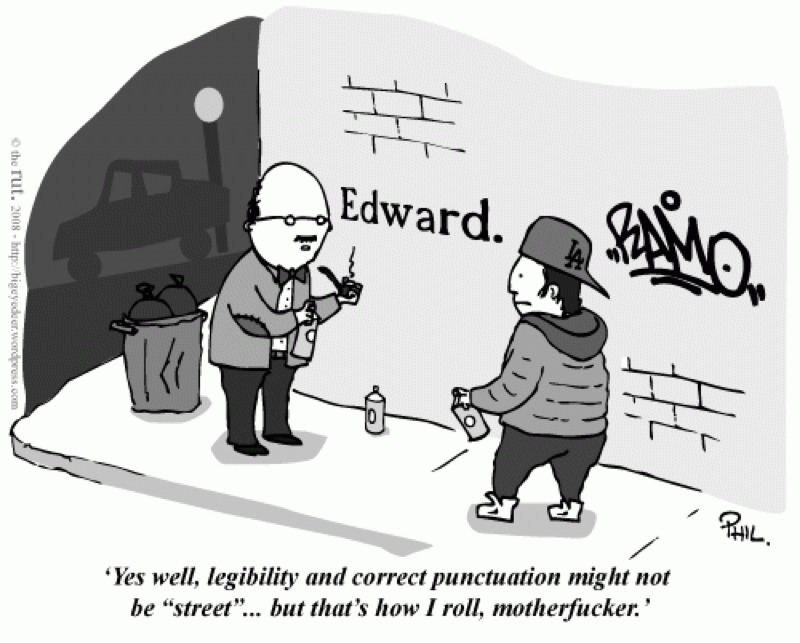
At school we were taught never to start sentences with “And”.
And yet newspaper journalists are trained to start a sentence with and. I do it all the time.
Not starting a sentence with And is one of the first so-called rules professional writers learn to break.
There’s nothing wrong with using “And” to begin a sentence or a paragraph. It is a great way to smooth the flow when you have a series of short sentences that would otherwise be too staccato for comfortable reading.
Go ahead, start a sentence with and
Only break this rule in moderation. Overusing “And” at the start of sentences quickly becomes boring.
As Keith Waterhouse points out in his excellent but old book on Daily Mirror Style, too many sentences starting with the word means your writing reads like the New English Bible.
I aim for only one “And” sentence start in a short piece of 300 words. For longer stories, you can get away with using it a few times - about once every 3-500 words. Control any urge to sprinkle sentences starting with “And” through your copy.
Other conjunctions
The school rule didn’t just apply to “And”. Starting sentences with other conjunctions was also forbidden. As an aside, conjunctions are ‘joining’ words used to string phrases together – usually, but not always, to build more complex sentences.
There are plenty of alternative conjunctions to call on at the start of your sentences:
“But” is a great way to start a sentence that disagrees with the previous one.
“Yet” is a less-frequently used alternative, it’s a little more nuanced.
“Or” is a great word for helping text flow.
Some people don’t like sentences to start with “However”. I would regard that as another rule worth breaking.
“Although” is a possibility. In practice, it can be better to shorten the word to “Though” at the start of a sentence.
Orwell on language
Everyone who thinks at all has noticed that our language is practically useless for describing anything that goes on inside the brain.
Some people think worrying about spelling and grammar is anal and backward.
They are wrong.
There are two non-anal reasons why spelling and grammar are important and will remain important for as long as people still read printed words:
First: Well-written, properly spelt (I’m British, this spelling is allowable), grammatically correct English is unambiguous.
Poorly written English is more open to misinterpretation.
If being understood is important, then worry about spelling and grammar.
Second: Well-written text flows, it’s a pleasure to read. It sends readers a message about your professionalism and wisdom. It is credible.
Poorly-written English jerks readers around, causes readers to stumble. They may not realise why this sets off alarm bells in their heads, but it does.
Too much poor English and they’ll question the message. This may not happen on a conscious level. It may not happen with all readers. It will happen enough for it to matter.
David Ogilvy: How to write
“Never use jargon words like reconceptualize, demassification, attitudinally, judgmentally. They are hallmarks of a pretentious ass.”
From a memo advertising man David Ogilvy sent to employees at his agency in 1982, titled: “How to Write”.
The verb of attribution
Earlier I wrote that most of the time you should use said when reporting someone’s words. Said is the best verb of attribution.
Said is a wise choice of word for journalists. It is neutral and judgement free. This makes it a safe and accurate choice.
A simple word like said is readily understood and unambiguous — that’s always a sign of good writing.
You might choose something else if you’re writing poetry, literature or fiction. Yet for everyday writing use the simplest option. Your readers will thank you.
The boring trap
Don’t let anyone tell you that sticking with said makes your writing boring. Nor should you listen to those who tell you the word is overused.
It is less boring than sitting through a defamation action because someone misinterpreted an alternative word.
It is less boring than expecting your reader to look up the meaning of an alternative word.
Readers can misunderstand almost every alternative to said.
This is just between us
The term ‘verb of attribution’ is correct. Yet, outside of academic discussions about language, it is not the best phrase to use in your writing.
‘Verb of attribution’ is the kind of formal, technical language that puts readers off, even when they know what it means.
First, second, third
Remember when list posts were all the rage?
There’s nothing wrong with writing lists – especially when publishing online – so long as you don’t overdo it.
When the list items are short, you can use bullet points. Or, if the order is important, choose numbered bullets.
Both options make text easy to scan and read quickly.
Another, more elegant, approach is to write out your list using a variation on the following theme:
First, something happened. Second, something else. Next, we used a little elegant variation to make things more interesting. Then, we did this. Last, we finished up.
Use sparingly
Ideally a list written this way should have only a few points. Keep it to four or five at most. Six is pushing it. Seven is far too many.
When writing numbers this way you should spell out the words from first to ninth1 then write 10th, 15th, hundredth. You should never get as far as ninth.
Some people use firstly, secondly, thirdly and so on. While strictly speaking both approaches are grammatically correct, adding -ly is old-fashioned and unnecessarily fussy.
What’s more, you’ll end up looking silly if you want to deal with lots of items and reach eleventhly or even millionthly.
So, stick with the simpler format.
or perhaps tenth. This depends on your taste or if you have one, your house style guide, but remember to stay consistent. ↩︎
Among and Amongst
Modern newspaper style books tell journalists to use among, not amongst.
Unlike many style book rules, this one applies on both sides of the Atlantic as well as in Australia and New Zealand.
While both words are technically correct, amongst is regarded as old-fashioned and may soon be obsolete.
My 40 year old copy of the Oxford Concise Dictionary offers the two words as alternatives.
According to the Oxford Dictionaries web site, no-longer online, among is “chiefly British”. This surprised me.
I checked my own work – almost 30,000 documents – and found I’ve used the word ‘amongst’ about 120 times compared with ‘among’ about 800 times. However, in recent years the ratio is much lower.
The Cambridge dictionary thinks Amongst is “more formal”. Merrian-Webster says people use amongst to sound more educated.
I found this online years ago. The original site is lost forever.
Hartman’s Law of Prescriptivist Retaliation says that any article or statement about correct grammar, punctuation or spelling is bound to contain at least one error.
It’s a version of Muphry’s law, which is not to be confused with Murphy’s law.
If you write anything criticising editing or proofreading, there will be a fault of some kind in what you have written.
I’m sure every freelance or contractor has reliable, predictable clients who are easy to deal with. The ones from left field can be another story. Just had one woo me for days, then reveal at the last minute they refuse to pay more than half the going rate.
When reporting someone’s words, it’s best to use said in most cases.
Newspaper and other style guides disagree over whether to use past tense (said) or present tense (says).
It doesn’t matter which. Pick one and stick with it. At times you may need to write someone says this now, but said something different in the past.
While you can use said even with written words - if you are quoting what someone wrote in a mail or in tweet - it is better to make it clear the person wasn’t talking at the time.
Alternative verbs are mainly pompous or value-laden. I once worked with a journalist who sprinkled his copy with words like averred or commented because he thought said was too dull.
Neither word adds useful information. The pompous language may frighten off some readers. To me it read like something from Edwardian times.
##Not using said sows seeds of doubt
Your readers may interpret any alternative to said as suggesting the speaker is lying, misinformed or doesn’t know what they are talking about. Think of claimed or according to.
It is perfectly OK to used claimed or according to when you want readers to understand there may be some doubt.
One alternative I allow myself is the verb ask. This only works when someone is clearly asking a question.
##How about when writing fiction?
Fiction writer Elemore Leonard has another perspective on this. In his excellent Ten rules of writing he said:
Never use a verb other than “said” to carry dialogue.
The line of dialogue belongs to the character; the verb is the writer sticking his nose in. But said is far less intrusive than grumbled, gasped, cautioned, lied. I once noticed Mary McCarthy ending a line of dialogue with “she asseverated,” and had to stop reading to get the dictionary.
Leonard wrote fast-paced fiction with terrific dialogue, if sticking with the one word was good enough for him, it is good enough for the rest of us.
Sharp-eyed readers will have noticed I wrote: Elmore Leonard said not says. The writer died in 2013, that’s definitely past-tense.
I always file my bi-monthly GST return and personal income taxes on time, but because my registered company is a one-man band and all the profits are paid as salary I never remember to file the business income tax return on time - it’s always zero.
On the whole the move from using Gmail for my own domain email address to using iCloud Mail has gone well. The only problem is some persistent spam is not picked up by iCloud while the more marketing-oriented yet legitimate incoming mail gets sent to the spam bin.
Segment covers fears of Pimeyes, a service that can find people’s photos on the internet and has an ethically troubling business model.
Also talk about people being more comfortable with fake faces than the real thing.
Cover Chorus' move to introduce 25 Gbps fibre broadband and the merger that means 2degrees is able to challenge the telecoms market leaders.
So it turns out the Google Docs file I spent a day working on and thought was lost was stored in a different client’s workspace. I only two clients who use Gsuite and forget to log-in and out of accounts at the right moments. Is there a workaround for this problem?
Apple’s voice recognition struggles with my accent.
I’m a pom who has lived in New Zealand for 25 years, was in Australia for 10. The British version doesn’t get me at all. The New Zealand option does better, but the Australian works best of all.
No. I can’t explain it either.
DIgital subscriptions that autorenew claim to be ‘convienent’ for customers. Yeah right.
On the other hand they are super convienent for the companies if their customers don’t keep a close eye on renewal dates.
Zoom works first time every time when I’m invited to a video conference meeting. Microsoft Teams generally requires a software reinstall and a MacOS reboot before a meeting can get underway.
This came today: 15 years with WordPress.
I switched to iCloud mail hosting because I can use my domain name.
On the whole everything works well, it’s at least as smooth as Gmail.
Except for spam. GMail is so much better at spotting spam. iCloud Mail misses half of it and censors too much genuine mail
Yeserday I was thinking “I haven’t had post-Covod brain fog for days now, perhaps it has gone for good”…
… no such luck.
A test post to see if Microblog is cross-posting to Twitter. It wasn’t earlier.
Had to print a document for the first time in at least a year. Amazing how awkward this feels in 2022.
The Download Weekly - latest edition of my newsletter covering New Zealand telecommunications