Bill Bennett writes: I nearly turned down the chance to review the Deebot Ozmo 900. At the time I was busy. Jo overheard the call and told me to ring back—she was keen. So keen she wrote the review.
Dennis, or, to use his proper name, Deebot Ozmo 900, has the wrong voice. It’s a woman’s voice. As a modern woman, I don’t believe vacuuming is a woman’s job.
The man of the house says he sounds like a female version of the toaster from Red Dwarf, the 1980s series about Dave Lister, the snack-machine repairman stranded three million years in the future.
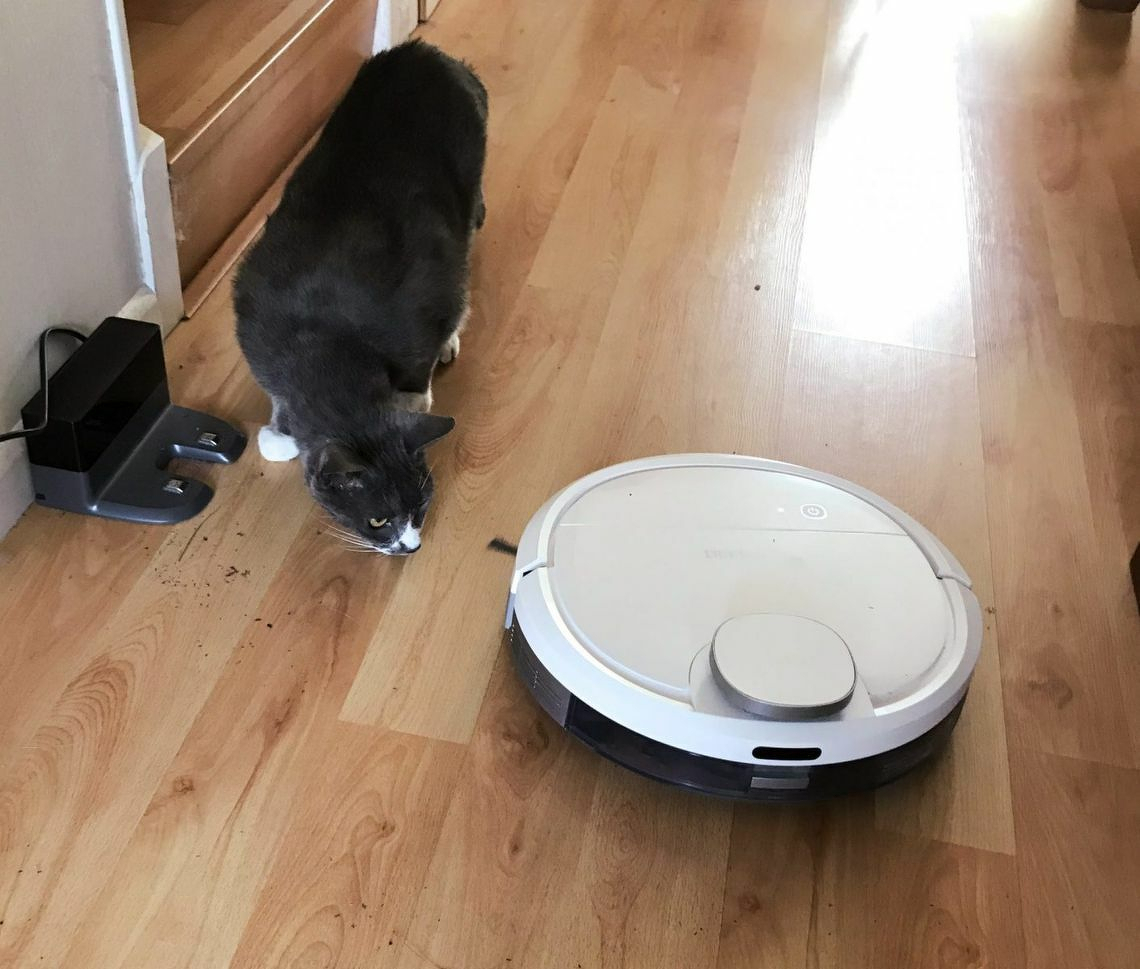
Dennis does at least look futuristic: a smooth white disc (320mm across, 70mm high) rolling around on wheels, equipped with a laser distance sensor, bumper and anti-collision sensors.
He has a docking station for charging and, unlike Red Dwarf’s toaster, smarter software. He builds room maps and comes with an app, with support for voice assistants.
Lovable, if slightly needy
Like many people, I quickly grew fond of Dennis. He feels less like an appliance and more like a useful pet.
He tells you when he’s tired—his battery is low—then trundles off to recharge. He’s part of a long line of steadily improving robot cleaners. There’s still room for improvement, but for many homes he would be a genuine help.
His party trick is mopping as well as vacuuming. That alone makes a difference.
He runs for up to 90 minutes when vacuuming, less when mopping at the same time. He’s cordless and mostly gets on with the job, but he does need supervision. Think of him as a two-year-old: capable, but prone to getting stuck and calling for help.
Cables and our television sideboard proved a challenge. That said, it was easy to work nearby and listen out for trouble.
Death to dust bunnies
Where Dennis shines is under the bed.
Dust bunnies are normally a miserable chore, involving awkward angles and a vacuum wand. Dennis simply glides underneath and deals with them.
On the downside, his tendency to get stuck limits the usefulness of the app. There’s little point starting a clean remotely if he might strand himself in a corner.
The app is also fiddly to install. Online forums suggest this is a common complaint. Ecovacs appears more focused on robotics than software.
Mapping and other limitations
Dennis’ mapping has limits. In a split-level home, he can only handle one map, so he keeps starting again.
In practice this is more annoying than fatal, although it may explain why he gets stuck in familiar places. His dustbin is small and needs frequent emptying. The water reservoir is also modest, so mopping sessions are short.
That said, the mop pad works well, especially on laminate floors where too much water would cause damage.
He is best suited to hard floors. He coped with a low-pile rug, but deep carpet would be a stretch.
A cleaner home
After several runs in a week, the house felt fresher. Air quality improved noticeably, suggesting he was picking up dust, pollen and pet dander.
Because he is automated, he is more likely to be used often. That alone helps keep on top of cleaning.
No longer a luxury
At around NZ$800, Dennis sits in the affordable end of the robot vacuum market.
Not long ago, this category was a luxury. While he can’t replace a traditional vacuum for everything—curtains and furniture still need attention—he is effective at what he does.
Cordless stick vacuums, like those from Dyson, cost more and are better for quick clean-ups. But they still need someone to do the work.
A robot vacuum is closer to a washing machine: it gets on with the job by itself.
Pros and cons
Dennis is compact and low enough to reach under furniture, although the raised sensor disc can catch on some edges. Setup takes a little patience—the manual is brief.
Maintenance is higher than with a traditional vacuum. Hair tangles around the brushes and needs cutting away.
He does get stuck more often than ideal. Better multi-room mapping would help, especially in multi-level homes.
On the plus side, the mopping function is genuinely useful, especially in homes with pets.
And despite fears raised in some reviews, he has no trouble with stairs. His sensors detect edges and turn him away. No cushions required—although, as the man of the house noted, it’s reassuring to know a Dalek invasion could be stopped so easily.
Fortunately, Dennis is far more helpful than that.
