In 2021 Apple moved ahead of the laptop pack with its M1-powered MacBook Pro. That model set new standards for processing power and battery life. This report from 2023 looks at how the M2 MacBook Pro takes performance and battery life further. It's not cheap, but the most demanding users will see it as a wise investment.
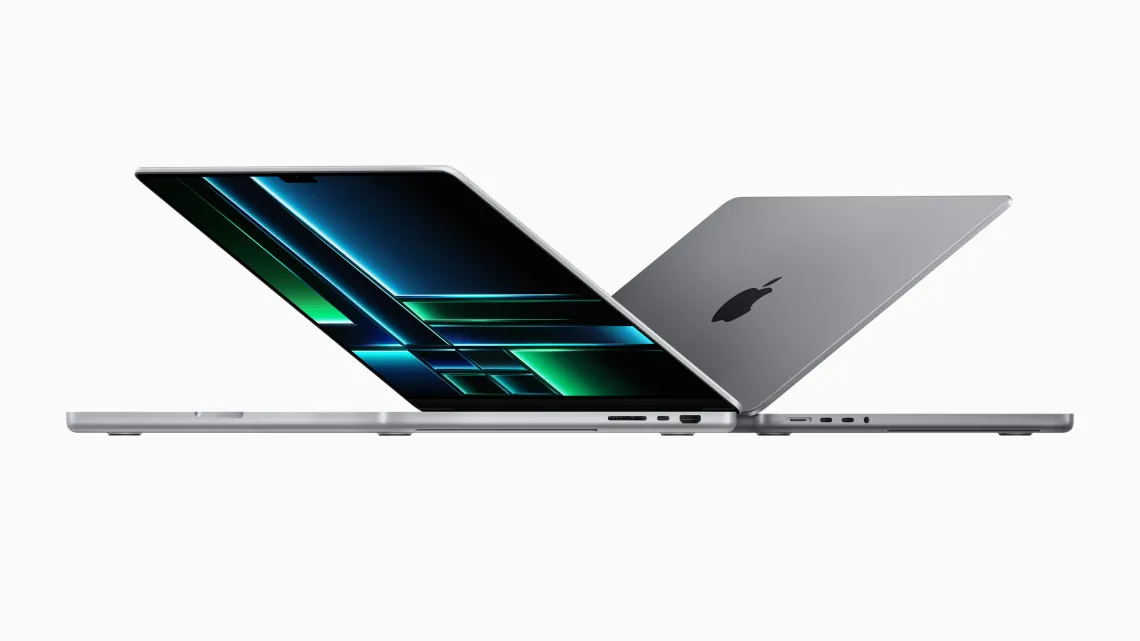
16-inch MacBook Pro at a glance
| For: | High performance, very long battery life, miniLED ProMotion screen, excellent speakers and great design. MagSafe. | |
| Against: | Expensive. Can’t upgrade Ram after purchase. No Ethernet port. | |
| Maybe: | Not compatible with Windows Boot Camp can run Parallels desktop. Webcam is excellent, but doesn’t feature Centre Stage. | |
| Verdict: | Every aspect is best in class. It’s an outstanding laptop for people who need power, but it comes with a hefty price tag. | |
| Price: | From NZ$4600. Review model costs NZ$6350. |
At first sight Apple’s 2023 MacBook Pro looks identical to the 2021 model. Externally, little has changed and that’s no bad thing.
The 16-inch model has a full-size backlit keyboard (280mm by 115mm). It’s the best I’ve used on a laptop, with a precise, comfortable feel. A Touch ID key handles security, making logins and payments quick and painless.
The trackpad is large (160 × 100mm) and superbly responsive—again, the best I’ve seen on any laptop.
Apple’s Liquid Retina XDR display is stunning. It refreshes at up to 120Hz, with sharp text, vivid images and, if needed, searing brightness. Apple quotes a 1,000,000:1 contrast ratio. On the review unit the 16.2-inch screen delivers 254 pixels per inch.
There’s also an SDXC card slot. In testing, file transfers from an older camera card were effectively instantaneous.
Raw computing power
The review unit has a 12-core M2 CPU: eight performance cores and four efficiency cores. The 2021 model’s M1 Pro had 10 cores, so the newer chip adds two efficiency cores.
In practice, this MacBook Pro is about 20 percent faster than its predecessor. That’s noticeable, though probably not enough to tempt 2021 owners to upgrade. Anyone coming from an Intel MacBook will see a huge leap.
Benchmarks only tell part of the story, so I focused on real-world tasks. Using HandBrake to encode a library of DVDs for Apple TV, the MacBook Pro completed the job in less than a quarter of the time taken by my 2020 Intel MacBook Air.
It’s not a gaming laptop, but it handles demanding graphics work with ease. Rendering lossless audio from a digital audio workstation took a fraction of the time compared with the MacBook Air.
Beyond that, I struggled to find anything in my workflow that could push the M2 to its limits.
Outstanding battery life
The 100Wh battery combined with Apple Silicon’s efficiency delivers extraordinary endurance.
Apple claims up to 22 hours of video playback. In a controlled test, with WiFi and Bluetooth off, moderate brightness, video looping, the MacBook Pro ran for 27 hours, comfortably exceeding that figure.
In everyday use, writing, browsing, light photo work and background encoding, I saw around 16 hours. That’s roughly two full working days on a single charge.
Long battery life changes how you use a laptop. You stop thinking about chargers, power points or rationing screen time. It feels closer to using a phone.
It’s also enough to cover most of a New Zealand–Europe flight, assuming you sleep part of the way.
Fast charging
Apple’s 140W power adapter delivers a 50 percent charge in about 30 minutes, with a full charge taking roughly 90 minutes.
MagSafe has returned, which means a stray foot won’t send your laptop crashing to the floor. You can still charge via USB-C if needed.
Video camera
Laptop webcams are often poor, but not here. The MacBook Pro has a 1080p camera with a four-element lens. In video calls, others consistently reported clearer images.
That clarity can cut both ways: during one call, someone spotted a competitor’s product on a distant desk.
Like modern phone cameras, it uses computational video powered by the M2’s neural engine to improve exposure, colour and noise. You can’t easily judge that from your own feed, but the results are obvious to others.
macOS Ventura also lets you use an iPhone as a webcam. On this machine, the built-in camera is good enough that the feature feels redundant.
Speakerbox
Laptop audio is usually an afterthought. Here, it’s a highlight.
While testing FL Studio, I accidentally switched from headphones to the built-in speakers. The difference was striking: full, balanced sound with real bass, that’s something laptop speakers rarely deliver.
The six-speaker system (four woofers, two tweeters) handles music and video calls with clarity and volume, with little distortion even at higher levels.
Apple also supports spatial audio. With compatible content, the effect is impressive. It won’t replace a hi-fi, but it’s ahead of any laptop I’ve used.
WiFi 6E and Bluetooth 5.3
WiFi performance is strong. With WiFi 6E support, you can use the less congested 6GHz band, assuming you have a compatible router.
In testing, downloads peaked at over 920 Mbps on a gigabit fibre connection, matching wired Ethernet speeds.
Weaknesses?
There’s a good selection of ports, but no built-in Ethernet. That’s usually fine, but I still needed a dongle to connect directly to a network drive.
Memory and storage aren’t user-upgradable. While repairs are possible, unofficial upgrades may run into restrictions.
Running Microsoft Windows
Apple Silicon Macs can’t use Boot Camp. Instead, I used Parallels Desktop to run Windows. It works well, but it’s expensive and comes with licensing complexity.
VirtualBox is a free alternative, but the Apple Silicon version remains unstable at the time of writing.
Talking points
-
You can spend far more on a laptop. Workstation-class machines like HP’s ZBook Studio cost considerably more in some configurations, yet the MacBook Pro often outperforms them.
-
Apple says a third of the machine uses recycled materials. Its environmental report is worth reading if sustainability matters.
-
macOS Ventura is close enough to Windows to feel familiar, while offering useful extras like using an iPad as a second display.
-
The display notch is easy to ignore, though not everyone will like it.
-
Even under sustained heavy workloads, the MacBook Pro stays cool and quiet.
-
There’s no Face ID. An odd omission given how well Face ID works on iPhone and iPad. Apple sticks with Touch ID.
-
Despite its size, the 16-inch model remains portable and well balanced—never clumsy.
-
Apple’s annual update cycle is also a marked improvement on the long gaps seen in the Intel era.
Verdict: 16-inch MacBook Pro
Apple’s 2023 16-inch MacBook Pro is an outstanding high-end laptop. It delivers immense performance and class-leading battery life, with few meaningful weaknesses.
It’s expensive. Prices start at NZ$4600 for a model with 16GB memory and 512GB storage. The reviewed configuration (32GB, 2TB) costs NZ$6350, while fully loaded versions climb far higher.
Even so, pricing is competitive with workstation-class PCs. If anything, Apple has the edge in performance per dollar.
