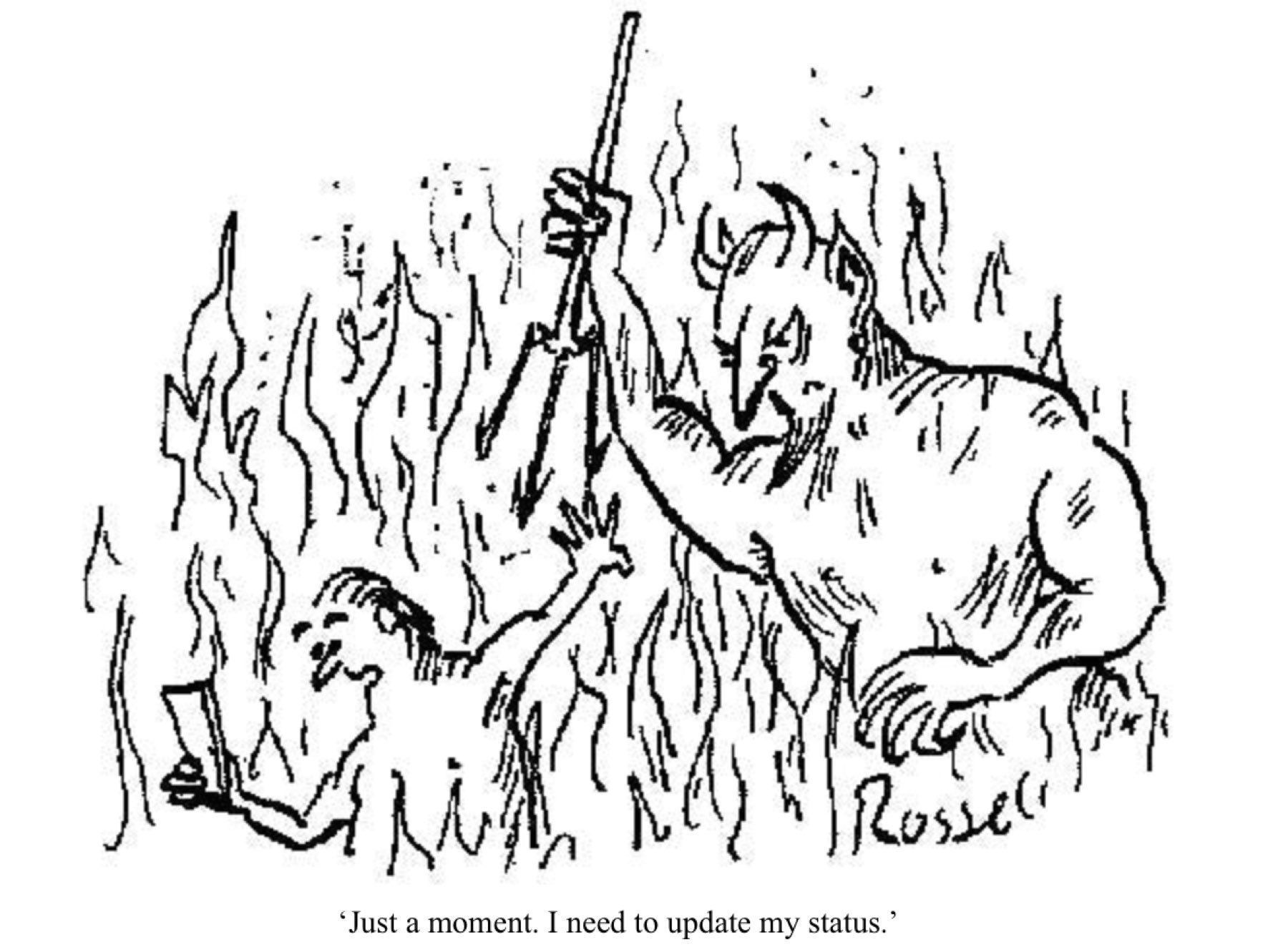
I’ve never understood why TV and radio news bulletins include reports on individual share price movements with little context.
If you are interested in what is happening to a share, you’ll want more than an occasional snapshot telling you “XYZ was up two cents at lunchtime”. You’ll probably have a ticker on your phone or computer.
And if you are not, then you’re more likely to mentally switch off and miss the next news item.
Ah, but a man’s reach should exceed his grasp, or what’s a heaven for?
— Robert Browning
Companies and insecure people often insist their job titles should be spelt with upper case letters. These are narcissistic capitals.
Using capitals this way is incorrect grammar — capitals are used at the start of proper nouns.
Bus driver is not a proper noun. Nor is marketing director or chief executive officer.
For that matter neither is president.
A job title can be a proper noun in some cases, that’s another issue.
No matter.
People who insist writers spell job titles in capital letters think it makes the person look more important. Or because they think some jobs are more important than others and deserve capitals for that reason.
As if ‘head of marketing’ isn’t already impressive enough.
Some people insist on using upper case even when they understand it is bad grammar. As my friend Chris Bell (no longer online) points out they worry that using titles correctly may show the world they are unduly modest.
So they deliberately show the world they are semi-illiterate instead. Give me literate any day.
At Psychology Today, Susan Krauss Whitbourne has another warning about narcissists and capital letters:
People high in narcissism, whether characteristically or on a given day, may try demand your immediate attention. Because it affects them, it’s urgent. If it’s a conversation you’re having in person, rather than over email, you may feel that what’s being said could be translated into words appearing all in capital letters, along with a few extra exclamation points.
Exclamation marks, some people call them bangs, have almost no place in serious writing.
Tabloids use them in headlines. You may use exclamation marks in reported speech or where they form part of a name or title.
And that’s it.
It’s no accident many newspapers and publishing companies ban exclamation marks.
They don’t add drama.
They don’t improve poor writing.
Exclamation marks don’t tell readers a sentence was funny.
They may tell readers a sentence was supposed to be funny. That’s quite different.
In the newspaper business, the exclamation mark is sometimes known as a shriek or screamer. These names give a clue to why they best left on the shelf.
It is often used to add emphasis to sentences. It’s versatile, you’ll see it used to show surprise, anger or joy.
You’ll see it used far too often.
The exclamation mark is the punctuation equivalent of raising your voice – maybe hysterically. Hence the name ‘shriek’.
Here’s why you should avoid them:
As an editor, I told a young reporter working for me who used one in a story that was his year’s allocation gone.
I was only half-joking. If you must use exclamation marks, use them rarely. Once a year is too often.
The reporter got the message. I never saw another one in his copy.
“I will ignore all ideas for new works and engines of war, the invention of which has reached its limits and for whose improvement I see no further hope.”
Julius Frontinus, chief military engineer to the Emperor Vespasian, circa AD 70.
A company can have many employees. Yet in law and in grammar it is a single entity. Use singular verbs.
You should always use singular verbs with companies, even when the company name sounds plural. The same applies to countries, political parties, governments and partnerships.
All are singular.
Some people think using they instead of it makes writing more personal. It can do. But that’s not the point.
Marketing departments like to use plural when writing about companies because they think that gives readers a point of connection. It makes us think we are dealing with human beings.
That may be true. Even if the company in question are a bunch of great people who really are fun to do business with. Yet that’s also not the point. The company still a singular legal and grammatical entity.
And anyway, we all know companies are staffed by humans.
The problem here is that incorrect grammar makes your writing and, more important, your meaning, unclear.
There is another reason. If you read a company described as plural in print on a website, that’s a clear sign that the writer, editor or publisher has second-rate grasp of language. Those of us who have worked for a long time in written communications know the writer or maybe whoever employed that writer, is unprofessional or, if that sounds too harsh, sloppy.
Most readers may not spot this as an error on a conscious level. Yet they know what professional writing looks like and many will subconsciously recognise the words in front of them are not professional, even if they can’t articulate why. They may have an inkling there is something wrong here.
When that happens they will be wary of what they read. Consciously or subconsciously they’ll think that if the writer doesn’t know enough to get simple grammar correct, it’s unlikely they did a professional job of fact-checking.
When you write they do you mean the company or all the people who work for the company? If you mean the employees, then make this clear. There’s nothing wrong with talking about, say, the staff at my local café.
Resist all temptation to treat companies as plurals. That goes for countries, political parties, governments and other organisations. It gets difficult with rock bands and sports teams which are now widely talked about as if they are groups of people. But there’s no legal implication in these cases.
The life of the journalist is poor, nasty, brutish and short. So is his style.
– Stella Gibbons, Cold Comfort Farm
At school we were taught never to start sentences with “And”.
And yet newspaper journalists are trained to start a sentence with and. I do it all the time.
Not starting a sentence with And is one of the first so-called rules professional writers learn to break.
There’s nothing wrong with using “And” to begin a sentence or a paragraph. It is a great way to smooth the flow when you have a series of short sentences that would otherwise be too staccato for comfortable reading.
Only break this rule in moderation. Overusing “And” at the start of sentences quickly becomes boring.
As Keith Waterhouse points out in his excellent but old book on Daily Mirror Style, too many sentences starting with the word means your writing reads like the New English Bible.
I aim for only one “And” sentence start in a short piece of 300 words. For longer stories, you can get away with using it a few times - about once every 3-500 words. Control any urge to sprinkle sentences starting with “And” through your copy.
The school rule didn’t just apply to “And”. Starting sentences with other conjunctions was also forbidden. As an aside, conjunctions are ‘joining’ words used to string phrases together – usually, but not always, to build more complex sentences.
There are plenty of alternative conjunctions to call on at the start of your sentences:
Everyone who thinks at all has noticed that our language is practically useless for describing anything that goes on inside the brain.
– George Orwell
Erin Brenner at the Writing Resource asks in a blog post: “Does spelling still matter?”
Yes it does. It still matters.
Some people think worrying about spelling and grammar is anal and backward.
They are wrong.
There are two non-anal reasons why spelling and grammar are important and will remain important for as long as people still read printed words:
First: Well-written, properly spelt (I’m British, this spelling is allowable), grammatically correct English is unambiguous.
Poorly written English is more open to misinterpretation.
If being understood is important, then worry about spelling and grammar.
Second: Well-written text flows, it’s a pleasure to read. It sends readers a message about your professionalism and wisdom. It is credible.
Poorly-written English jerks readers around, causes readers to stumble. They may not realise why this sets off alarm bells in their heads, but it does.
Too much poor English and they’ll question the message. This may not happen on a conscious level. It may not happen with all readers. It will happen enough for it to matter.
“Never use jargon words like reconceptualize, demassification, attitudinally, judgmentally. They are hallmarks of a pretentious ass.”
From a memo advertising man David Ogilvy sent to employees at his agency in 1982, titled: “How to Write”.
Earlier I wrote that most of the time you should use said when reporting someone’s words. Said is the best verb of attribution.
Said is a wise choice of word for journalists. It is neutral and judgement free. This makes it a safe and accurate choice.
A simple word like said is readily understood and unambiguous — that’s always a sign of good writing.
You might choose something else if you’re writing poetry, literature or fiction. Yet for everyday writing use the simplest option. Your readers will thank you.
Don’t let anyone tell you that sticking with said makes your writing boring. Nor should you listen to those who tell you the word is overused.
It is less boring than sitting through a defamation action because someone misinterpreted an alternative word.
It is less boring than expecting your reader to look up the meaning of an alternative word.
Readers can misunderstand almost every alternative to said.
The term ‘verb of attribution’ is correct. Yet, outside of academic discussions about language, it is not the best phrase to use in your writing.
‘Verb of attribution’ is the kind of formal, technical language that puts readers off, even when they know what it means.
Remember when list posts were all the rage?
There’s nothing wrong with writing lists – especially when publishing online – so long as you don’t overdo it.
When the list items are short, you can use bullet points. Or, if the order is important, choose numbered bullets.
Both options make text easy to scan and read quickly.
Another, more elegant, approach is to write out your list using a variation on the following theme:
First, something happened. Second, something else. Next, we used a little elegant variation to make things more interesting. Then, we did this. Last, we finished up.
Ideally a list written this way should have only a few points. Keep it to four or five at most. Six is pushing it. Seven is far too many.
When writing numbers this way you should spell out the words from first to ninth1 then write 10th, 15th, hundredth. You should never get as far as ninth.
Some people use firstly, secondly, thirdly and so on. While strictly speaking both approaches are grammatically correct, adding -ly is old-fashioned and unnecessarily fussy.
What’s more, you’ll end up looking silly if you want to deal with lots of items and reach eleventhly or even millionthly.
So, stick with the simpler format.
or perhaps tenth. This depends on your taste or if you have one, your house style guide, but remember to stay consistent. ↩︎
Modern newspaper style books tell journalists to use among, not amongst.
Unlike many style book rules, this one applies on both sides of the Atlantic as well as in Australia and New Zealand.
While both words are technically correct, amongst is regarded as old-fashioned and may soon be obsolete.
My 40 year old copy of the Oxford Concise Dictionary offers the two words as alternatives.
According to the Oxford Dictionaries web site, no-longer online, among is “chiefly British”. This surprised me.
I checked my own work – almost 30,000 documents – and found I’ve used the word ‘amongst’ about 120 times compared with ‘among’ about 800 times. However, in recent years the ratio is much lower.
The Cambridge dictionary thinks Amongst is “more formal”. Merrian-Webster says people use amongst to sound more educated.
You can tell from my review that I liked the Microsoft Surface Laptop Go 2. billbennett.co.nz/microsoft…
If I was buying a Windows laptop this week I’d choose it.
I found this online years ago. The original site is lost forever.
Hartman’s Law of Prescriptivist Retaliation says that any article or statement about correct grammar, punctuation or spelling is bound to contain at least one error.
It’s a version of Muphry’s law, which is not to be confused with Murphy’s law.
If you write anything criticising editing or proofreading, there will be a fault of some kind in what you have written.
Going by last night’s game, it’s only a matter of time before Ireland beats New Zealand in the cricket. Heaven knows it was traumatic enough when they beat the All Blacks.
I’m sure every freelance or contractor has reliable, predictable clients who are easy to deal with. The ones from left field can be another story. Just had one woo me for days, then reveal at the last minute they refuse to pay more than half the going rate.
When reporting someone’s words, it’s best to use said in most cases.
Newspaper and other style guides disagree over whether to use past tense (said) or present tense (says).
It doesn’t matter which. Pick one and stick with it. At times you may need to write someone says this now, but said something different in the past.
While you can use said even with written words - if you are quoting what someone wrote in a mail or in tweet - it is better to make it clear the person wasn’t talking at the time.
Alternative verbs are mainly pompous or value-laden. I once worked with a journalist who sprinkled his copy with words like averred or commented because he thought said was too dull.
Neither word adds useful information. The pompous language may frighten off some readers. To me it read like something from Edwardian times.
##Not using said sows seeds of doubt
Your readers may interpret any alternative to said as suggesting the speaker is lying, misinformed or doesn’t know what they are talking about. Think of claimed or according to.
It is perfectly OK to used claimed or according to when you want readers to understand there may be some doubt.
One alternative I allow myself is the verb ask. This only works when someone is clearly asking a question.
##How about when writing fiction?
Fiction writer Elemore Leonard has another perspective on this. In his excellent Ten rules of writing he said:
Never use a verb other than “said” to carry dialogue.
The line of dialogue belongs to the character; the verb is the writer sticking his nose in. But said is far less intrusive than grumbled, gasped, cautioned, lied. I once noticed Mary McCarthy ending a line of dialogue with “she asseverated,” and had to stop reading to get the dictionary.
Leonard wrote fast-paced fiction with terrific dialogue, if sticking with the one word was good enough for him, it is good enough for the rest of us.
Sharp-eyed readers will have noticed I wrote: Elmore Leonard said not says. The writer died in 2013, that’s definitely past-tense.
I always file my bi-monthly GST return and personal income taxes on time, but because my registered company is a one-man band and all the profits are paid as salary I never remember to file the business income tax return on time - it’s always zero.
On the whole the move from using Gmail for my own domain email address to using iCloud Mail has gone well. The only problem is some persistent spam is not picked up by iCloud while the more marketing-oriented yet legitimate incoming mail gets sent to the spam bin.